Ever since it first came back in 2005, Doctor Who has been animated by two major things: the big emotions of its major characters on one end of the spectrum, and high-concept, complicated ideas on the other.
The show has gone through phases, sometimes being more enamoured by one of those over the other. The early years, particularly Christopher Eccleston's run, felt deeply emotive, while the Matt Smith era was driven by elaborate concepts and deep dives into lore.
Its latest Christmas special 'Joy to the World' (written by series stalwart and former showrunner Steven Moffat) takes both of these poles of Who and smashes them together. The result is interesting, even if it can't always tie its many threads and concepts together.

Related: Doctor Who's Joy To The World Christmas special could shine brighter
The Doctor (Ncuti Gatwa) is alone again, roving through time and space, and finds himself in the lobby of the Time Hotel. He wanders through wearing a dressing gown, newspaper and mugs in hand, hoping to fill them with coffee. He's stopped by hotel security, the unassuming Trev (Joel Fry), who insists that refreshments are for hotel guests only, before commenting on the fact the Doctor is carrying two mugs.
They say they "can never get used to them leaving" – it's this loneliness that animates the most interesting part of the special, showing the Doctor at their most human in a long, long time.
What to Read Next
While waiting in the Time Hotel, the Doctor sees a stranger with a briefcase handcuffed to their wrist, who speaks the mantra: "The star seed shall bloom and the flesh shall rise."
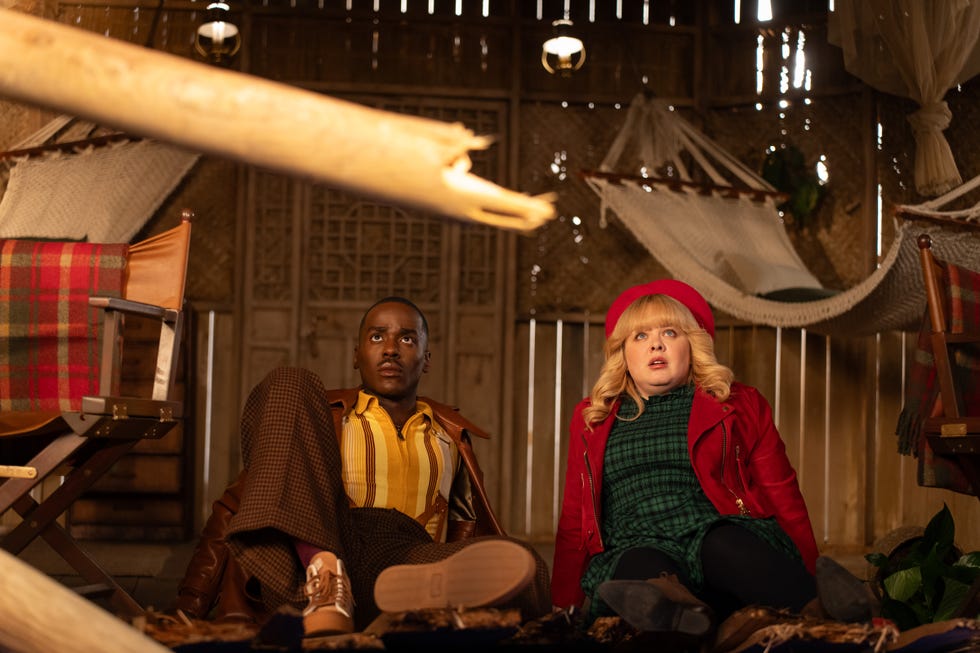
Anyone who takes the case off of them will have it bound to them, and its former wearer will disappear into stardust. It's in trying to understand this case that the Doctor encounters Joy (Nicola Coughlan), who's spending Christmas alone in a hotel room on Earth in 2024 (the Time Hotel is geographically linked to hotel rooms at different spots in space and time, finally answering the question of what that one locked door in every hotel room is for).
The dialogue around the suitcase – which threatens to explode as Joy wears it and the Doctor tinkers with its inner workings – is rapid-fire, and made all the more complicated when a version of the Doctor from the future appears, shouting a code at their past self.

Related: Doctor Who's Ncuti Gatwa shares what he wanted to bring to the role
Future Doctor insists that the past one needs to "take the long way round" to understand the code. The two Doctors have it out, trying to get to the bottom of why people have a habit of leaving them.
Future Doctor pulls Joy through the door, back into the Time Hotel, while Present Doctor finds themselves stuck in this terrestrial hotel for a whole year (the reason why is another elaborate piece of timey-wimey stuff that doesn't really need to be understood, which might be for the best because of how impenetrable it is).
Trapped on Earth and reminded of the crude reality that money is a prerequisite for survival, the Doctor ends up working at the hotel, and forming a deep friendship with receptionist Anita (Steph de Whalley).
The year is presented in montage as weeks turn into months, as the clocks go forward and back – as the Doctor and Anita fix things together, play boardgames, drink cocktails on a balcony and lament their love lives.
It feels genuinely ambitious to dedicate so much of the episode to asking the question of what would happen if the Doctor just lived in a straight line without some looming threat on their tail.
There are some references to the lore and history of the show – the Doctor collects models of blue public call boxes, saying that they're "all over the internet for some reason" – but it would be easy to forget everything that came before this second act, with the Doctor's farewell to Anita serving as a well-earned emotional payoff.
But, of course, all good things must come to an end. It's after a year passes and the Doctor returns to the Time Hotel that 'Joy to the World' begins to swing in the other direction.
They find themselves yelling the secret code at their past selves. It's correct but seems to come from nowhere, as the Doctor says to Joy, "It was completely random, but so was the universe", indulging in a hand wave and then a lore dump.

It's here that both the viewer and Joy are caught up to speed with the contents of the mysterious suitcase: a star that a weapons manufacturing company wants to take back through time so that it has the time to grow and expand, providing them with a limitless energy source.
This, in theory, could be the plot for the rest of the episode, but it also ends up being hand-waved away in favour of spending time with Joy. When she has the briefcase handcuffed to her wrist, she falls under its mind control and loses her sense of self.
The Doctor wakes her up by making her angry – criticising her mood, her hotel room and her mother.
It's this final point that pushes Joy over the edge and brings back those big, operatic feelings that define some of the best of Doctor Who. Joy reveals that her mother passed away on Christmas Day in 2020, furious that she "followed the rules" and listened to people "with their parties and their wine fridges", a blunt political critique that could ring true with too many people.
Related: Miriam Margolyes returns to Doctor Who in new role
The scene isn't subtle, but it doesn't need to be, because it's about all of the messy contradictions that come with being human (the thing that's a hallmark of the best episodes of Doctor Who).
Coughlan's performance is never just angry, although of course she's furious. It's embedded with sadness, regret and betrayal.
The twist and turns of the plot that take place around this character study are engaging, but never the most interesting thing on screen – even when one door in the Time Hotel reveals a prehistoric spectacle and another takes the Doctor and Joy back to where it (or, at least, Christmas) all began.
Between this and the way that the Doctor shouts "joy to the world" from the top of a mountain, there's a self-satisfaction to these final moments that, while working as a kind of punchline, threaten to undermine the sad, angry, complicated humanity that animates so much of the episode's best moments.
Doctor Who airs on BBC One in the UK and Disney+ elsewhere. Classic episodes of Doctor Who are available on BBC iPlayer in the UK.
Interested in talking about Doctor Who? Visit our dedicated sub-forum