
Last Breath – currently trending on Prime Video – tells the gripping story of British oil-rig diver Chris Lemons, who was marooned at the bottom of the North Sea after his support ship's control systems blacked out, and incredibly managed to survive for almost 30 minutes without oxygen.
In the film, the ship's dynamic-positioning system malfunctions during a heavy swell and high winds. It might seem like Hollywood exaggeration, but operating in those conditions was in fact normal, according to Lemons. He nonchalantly told the Guardian, "We don’t really notice that on the bottom.”
When alarms started ringing in the ship, the divers had to return to the diving bell. Rising to the surface wasn't an option, because they'd spent days in a high-pressure environment in order to accustom their bodies to the water pressure 300m under the surface. "You would die from explosive decompression pretty quickly," Lemons said.
When the ship began to drift, pulling the diving bell and Lemons by his umbilical tubes, he soon became trapped. "I was thrashing around like a fish trying to get out of there, shouting for slack. My next thought was that if it continued to slip, there was a small gap in the structure I was going to get pulled through, like being pulled through a cheese grater."
Luckily – though it might not have seemed it sooner after – the cable snapped. That meant Lemons only had his ten-minute air supply to live on, while also having to find his way to the top of the manifold he was working on so that his colleagues Dave Yuasa and Duncan Allcock could rescue him in the dark.
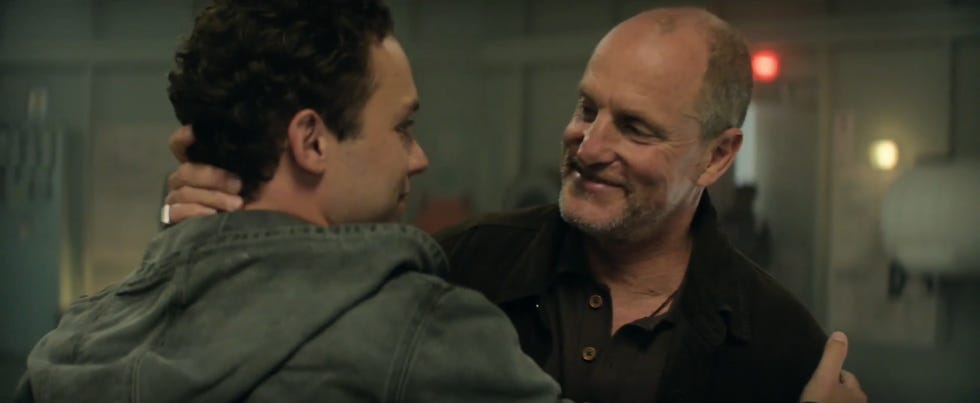
In Chris's haunting words: "When I got there and looked up, there was nothing but the most absolute blackness in the sea above me […] With nobody there, I decided this was probably going to be it. In a strange way, that had a calming effect; the fear, the panic drained out of me – there was nothing I could do. I assumed a sort of foetal position and was overtaken by grief. A great sadness took over at that point."
What to Read Next
In the film, Chris is still waving when the remote cameras find him; he may have been moving his arm, but in reality, he was unconscious. He suggests that if they were able to see movement, it was the involuntary movements of a drowning man.
After 29 minutes Dave Yuasa was able to rescue Chris and transfer him into the diving bell, where Duncan Allcock revived him using mouth-to-mouth resuscitation despite his 29 minutes of oxygen starvation.
"The actual moment was peaceful," Chris said. "I feel like a bit of a charlatan. I still get contacted all the time by people who’ve lost loved ones, but I don’t have the right to tell you what it’s like – I didn’t die."

How did Chris survive without oxygen?
As the closing cards of the film say, medical experts are unable to explain his survival and full recovery.
One theory is that the cold put him into a hypothermic state, almost like hibernation, that enabled his body to keep functioning at a low level. "But I’ve learned that if my body had been so cold that I’d gone into some kind of hibernation or stasis," he said, "there is no way Duncan would have been able to resuscitate me that quickly.”
It's also probable that having lived in a high-pressure container for several days, his blood was more enriched with oxygen than would be normal at surface levels. The Guardian also reports that high levels of CO2 – such as those he would have experienced, having nothing but his own exhalations to breathe – can in fact protect the brain in particular circumstances.
We'll never know for sure, because doctors weren't able to perform tests on him immediately after his recovery – he spent another three days decompressing in Aberdeen before he could be treated or tested.
What happened to Chris Lemons after his ordeal?
The emotional through-line of Last Breath is Chris's connection to his fiancée Morag, who hates the dangers he puts himself through. It's his shame at having let her down that haunts Chris as he faces almost certain death.

As the credits sequence shows, the two married – but real life rarely lives up to Hollywood's ideals, and they have since split up.
Chris has a new partner and two children and now works as a diving supervisor – like Mark Bonnar's character in the film – and public speaker. Yuasa continues to work as a diver, for Boskalis Subsea Services (the same company as Chris), though Duncan Allcock has retired – or "hung up his fins" as they put it.
The events of the film are almost identical to real life – as viewers of the 2019 documentary also called Last Breath will attest – but there were a couple of superficial changes: Allcock is not a Texan like Woody Harrelson – he's from Derbyshire. And unlike Finn Cole, Chris Lemons is bald. "Lush head of hair, good-looking lad – makes complete sense," he joked.
Last Breath is available to stream now on Prime Video.
The new edition of Living Legends is here! Buy Ariana & Witches in newsagents or online, priced at just £8.99.
Editor, Digital Spy Chris has over 25 years' experience as a writer and editor, having worked as a journalist covering TV and movies since the '90s. Starting out as a TV listings editor at the Press Association, he was quickly hired by the nascent Heat magazine, where he rose to become Senior Editor, interviewing the likes of Simon Cowell, Boris Johnson and Paris Hilton. Over the years he has written about entertainment with clarity and wit for Heat, Elle, Q, The Telegraph and of course Digital Spy, and has served many times as a judge in the Royal Television Society awards. He has written and recorded a novelty single with Lord Lloyd-Webber, written scripts for the National TV Awards, made Noel Edmonds cry, accidentally punched an Inbetweener and stolen a small piece of rubble from the Battle of Hogwarts movie set. (They can't have it back.) LinkedIn


