
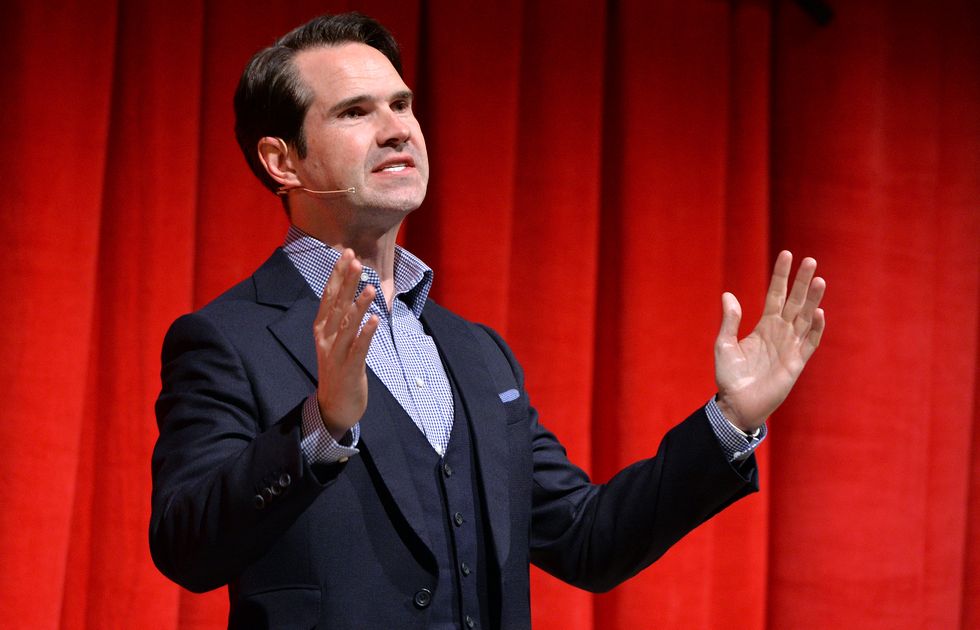
Unquestionably one of the defining British stand-ups of the past twenty years, Jimmy Carr is known for his edgy, joke-heavy material, but also for his sheer graft. He's a joke technician: he gets up in the morning, writes jokes, tests jokes, refines jokes and goes on stage eight times a week to perfect them until he has turned comedy ore into diamonds.
Digital Spy now has a magazine out on newsstands devoted entirely to British Comedy Legends, in which we speak to the cream of British stand-up.
Jimmy literally wrote the book on joke-writing: The Naked Jape (with Lucy Greeves). There are few people who can claim to have studied comedy as closely, and as such he's the ideal person to explain it to us…
Who was your inspiration?
I always liked wordplay and clever stuff. If it was one person, probably Ben Elton, because you'd watch something like Saturday Night Live, then you'd watch The Young Ones and BlackAdder – Ben is the through-line through all of that. I don't think he gets the credit he deserves for being a singular voice in British comedy.
Did you know about the tradition of stand-up comics he was following at the time, or did you catch up later?
What to Read Next
Culture lags behind technology. VHS was a huge thing for me. In the early '80s we'd start to see tapes of Robin Williams, who we'd seen on Mork and Mindy. Suddenly you could see him live talking about his cocaine addiction, and as a kid you'd go, "Who the f**k is this guy?"

Chris Rock for me is the GOAT, because if you look at Bigger and Blacker, it all stands up. Those routines don't just stand up, they're still edgy now. It's extraordinary. Most comedy rots, it goes back in the pot and that's great. But every now and then someone just comes along and nails it.
What made you want to be a comic?
I think a lot of people who suffer a little from depression self-medicate with comedy. I was "using" it and decided to become a dealer. I often think of myself like a drug dealer – you're dealing in seratonin and dopamine. You experience it most when you're in a group of other people – when you're laughing together, you laugh I think 30 times more. It's a very social, mimetic thing.
Yet a lot of comedy today is consumed in clip form.
Pornography is to sex what clips of comedy are to seeing a show. You can watch something on TikTik and go, "Oh, it's not very good," but you watched it with the sound down, reading subtitles while taking a shit. You didn't get the full effect.
Did you have the urge to perform as a kid?
I didn't dare to dream about showbusiness because I lived in a world where there was no connection to it. You're sometimes limited by your dreams. I was reasonably bright academically but dumb in terms of doing the next thing that was in front of me.
I look back at school, and everyone was hilarious. I didn't stand out as being the funny kid. I could definitely hold my own but everyone was fun. Why else would you be friends with someone if they weren't a laugh?
That was the currency, certainly in my home. If you're talking to a lot of comedians for this issue you should ask which of their parents was sick. Most comics had a parent who was either physically or mentally sick, and they had to be able to move the mood in the house.
Was that true for you?
100%. My mother was hilarious and effervescent and funny, but coupled with that she suffered with depression. You don't see that when it's your house, when you're a kid, it's just normal. Then the bug becomes a feature – what do you find easy that other people find difficult? That's often a good place to think about making a career.
Do you believe there's such a thing as funny bones?
People say it's either hard work or inherent genius, but it's always a mix. Someone had an aptitude for this thing and then they worked hard at it. I don't think it's any different from sports – it doesn't matter how good Michael Jordan is, if he didn't turn up to training he's just a guy who had some aptitude and didn't make it.
There's a lot of mysticism around comedy, like, "He's just funny, he just gets up there and does it." No! When I watch Chris Rock do a special I see 100 jokes that work brilliantly, but what I don't see is the 2000 jokes that didn't work that got him to those that did. He had to put the work in.
You don't have this in music – The Beatles aren't any less magical because you can write down the tunes and analyse the notes. I think we should teach comedy like we teach music.
But you do get musical prodigies. You can teach people to write songs but you can't teach them to be Paul McCartney.
That's true, but he makes my point: he was in a covers band with his friends, the Quarrymen. They were fine. Then he did 10,000 hours' work in Hamburg and suddenly his facility with melody was revealed.
What's your favourite joke that you ever wrote?
It's the last one I wrote. I do eight shows a week, and at the end of each show I get a piece of paper out of my pocket, today's jokes. Whatever the last one that worked is, that's the dopamine: that thing worked.

What is the gag you wish you'd written?
Anthony Jeselnik has a routine about modern-day slavery that I don't think you should print but it's a remarkable piece of work. I'd really encourage people to check him out. Shane Gillis is everyone's discovery of the last 12 months, an extraordinary talent at sketch and standup. Beth Stelling I absolutely love. Check out Neil Brennan's specials – Neil makes me want to be a better comic.
Finally, why did the chicken cross the road?
I mean I quite like those formatted gags, but… I don't know. I don't know.
You can see Jimmy in Last One Laughing on Prime Video, and tickets for his brand-new live tour, Laughs Funny, are on sale now.
Buy Digital Spy's British Comedy Legends in newsagents or online now, priced at £7.99.



Editor, Digital Spy Chris has over 25 years' experience as a writer and editor, having worked as a journalist covering TV and movies since the '90s. Starting out as a TV listings editor at the Press Association, he was quickly hired by the nascent Heat magazine, where he rose to become Senior Editor, interviewing the likes of Simon Cowell, Boris Johnson and Paris Hilton. Over the years he has written about entertainment with clarity and wit for Heat, Elle, Q, The Telegraph and of course Digital Spy, and has served many times as a judge in the Royal Television Society awards. He has written and recorded a novelty single with Lord Lloyd-Webber, written scripts for the National TV Awards, made Noel Edmonds cry, accidentally punched an Inbetweener and stolen a small piece of rubble from the Battle of Hogwarts movie set. (They can't have it back.) LinkedIn


