
The BBC's gritty reimagining of Ian Rankin's detective John Rebus – who is no stranger to a screen adaptation – is here, with Outlander star Richard Rankin (no, they're not related) stepping into those fairly large boots.
Ahead of the show's premiere, we sat down with the leading actor to discuss the expectations that were attached to his approach, finding the balance of putting his own stamp on the role, and the series' "important" decision to delve into the mental health and vulnerability of the character.

Can you talk about your approach to a character who's so beloved in Scotland? He's such an iconic character.
He's a very iconic character. He's one of the, I suppose, most iconic Scottish detectives, and is still very much present in Ian Rankin's novels. He's got such a big fanbase.
So I think taking it on, I was probably aware that there'd be certain expectations and anticipation. And they would have their own version of what they think the character should look like – which I think is good to be aware of.
To do the character as much justice as possible, I think you have to just acknowledge that, and park it, because you're not going to be able to give every version of everyone's expectations.
What to Read Next
I just started researching the character. I had been given some points of reference from Greg [Gregory Burke, Writer and Executive Producer] in terms of what parts of Ian Rankin's books he'd referenced.
Over the years, I've read a few Rebus books anyway, so I'm familiar with the character, and I'd watched the previous iterations of it.
But I was also very aware that this isn't a reboot, and it's not a sequel. They're very much a reimagining of the world of Rebus.

Did you want to reimagine the character, and make it your own, almost, and try and find the balance between the two?
You've just simplified something I've been trying to say all day. Yeah! That's exactly what I wanted to do.
Obviously, the character is younger, and the world and the place are in a different time. It's more contemporary, but we've gone back in terms of the story.
So the whole landscape has changed. I wanted to sort of understand what my concept, and what my version of the character was going to be, and to bring and do as much justice as I could to the written, literary version of Rebus – and to knit that together with Greg's version. And obviously with my own sort of angle on it...
I tried to understand this character, and what makes him tick – his psychology, and what his morals are – and to bring it all into this new, exciting, dark, gritty world that Greg's drawn up for us; this stage that he's given us, which I think is just incredible. I think what he's done is really, really great.
Episode one's opening sequence, we know right from the get-go that John Rebus is morally ambiguous. He has a bit of a temper. What can you share about the emotional journey he's going to go on?
Well, isn't it great, that whole scene?
Yeah, it opens with a bang!
It does open with a bang, but it does so much. To touch on basically everything you're saying – it tells us what his capabilities are. It tells us how potentially dangerous he can be. It tells us that he can have a short fuse. It tells us that, you know, his sort of moral compass can kind of be questionable, but ultimately he's always trying to do the right thing.
He might go above and beyond the law to achieve it. The end can justify the means for Rebus a lot of the time. I think deep down, he's a good man... I have no question about that. It's just that the way he goes about things can be, you know, potentially questionable...
And then from that point on, whenever you see him in any sort of potential conflict or a situation that looks like it might get dramatic – you know what he's capable of.
So you think: oh, is he, or isn't he, going to snap? Is he going to kick off? Is he going to punch the guy in the face? It did a lot for me as an actor because it meant I could just kind of throw someone a look, like: things might kick off here.
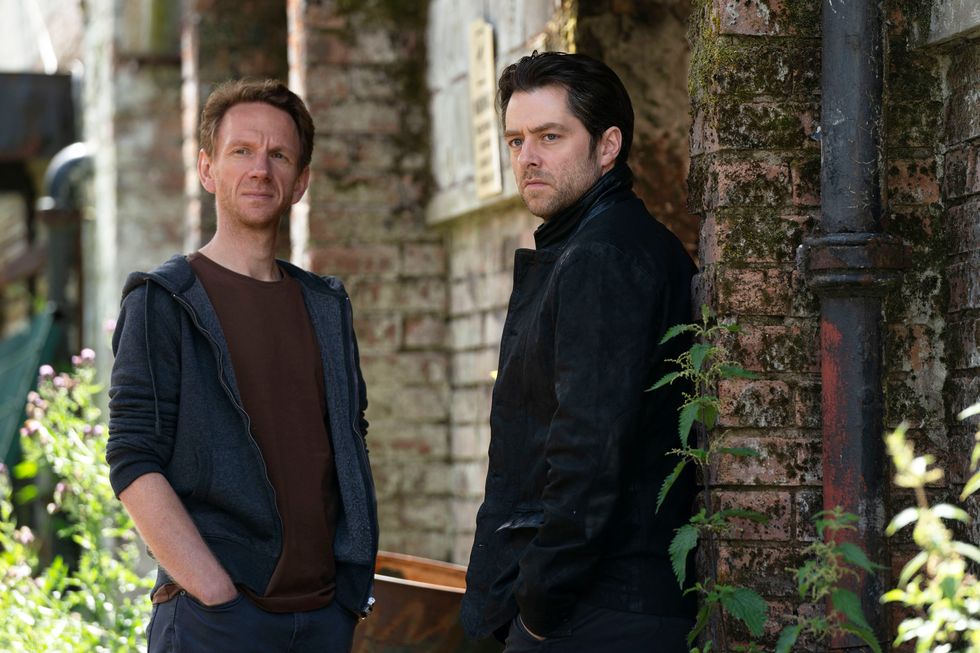
There's clearly quite a complicated relationship going on with John's brother, Michael. Can you tell us what it was like to film the scene where you break his jaw, and how that relationship with Michael informs the story?
The punch... it just emphasises and underpins him as a man, the relationship he has with his brother, and I think the world he comes from. It was important to me that it comes from utterly nowhere. You didn't see it on his face. It just comes from nothing.
Again, that helps me establish who he is. It helps me establish the character. But it also kicks off this relationship with sort of has a parallel element to it through the whole season with him and his brother.
His brother is kind of potentially crossing a line, and potentially getting himself in a bit of trouble. Rebus is obviously a cop. What does that mean? What's going to come of that? You know there's potentially going to be some sticky situations for Rebus.
I mean, Brian [Ferguson] – I think Brian's great. He's an actor I've always admired. He's an incredible character. I think his take on Michael is absolutely spot on.
Between the conversations we'd had, and how we wanted to establish that relationship and those characters, I think we got it to a really strong, interesting place where these characters come across in a way where I think they are so similar in so many respects.
I think Michael is as volatile as Rebus – maybe more volatile. I think he's just as dangerous.
But I think Rebus through… For whatever reason – whether it's because he's come from the police force; whether it's because he had a different experience when he was soldier – he keeps more of a lid on it.
Of course, with a lid on it, he'll get more of a build-up of pressure. But Michael is more transparent about how he's feeling, and what he feels. You can maybe see it coming a bit more, whereas Rebus is a wee bit more closed off.
But I think the brothers are very, very similar, and I think that just helps to deliver a more sort of intriguing relationship in the story.

The therapy scene at the beginning of episode two brought such a different dimension to the character. How important was that for you to explore?
So important. It was one of my – do you say "favourite" scenes? I think it was one of my favourite scenes. It was certainly, to me, one of the most important, if not the most important.
So it's interesting that you ask about it, because it serves so many purposes. You're seeing him in a light that you wouldn't ever get to see him in any other situation with any other person.
He doesn't want to talk about his feelings, but we are exploring his sort of mental health, and that's such a delicate thing anyway. And it allows me the opportunity, I think, to show his sort of psychology, and the inner workings of his mind, and how he functions.
He gets caught off-guard. He thinks he has this whole façade on. He thinks he has this whole mask on. He thinks he doesn't need therapy. He thinks it's useless. He's very traditional.
He's an old-fashioned cop. I think that shows itself in a lot of ways, and the therapy is one of them, when he goes into it.
He's just bullshitting. He tries to. He talks about his therapy – he talks about it later on... he's like, 'I'm doing her a favour. I'm helping her out. Poor woman, she's just trying to do her job. I don't even need therapy. The whole convention of it is utterly useless.'
But I don't think he actually believes that, and I think it is helping him. And I think he's getting to the root of a lot of things, and the reason why he is a lot of ways, and the reason why he's self-destructive, and the reason why he's so stubborn, and the reason why he's a martyr to his own sort of cause.
And it's because there's a lot of things going on there. There's a lot of pain there. There's a lot of anguish going on there. There's maybe even some PTSD from being a soldier. We don't quite get to touch on all of that yet, but the potential of the therapy scenes, to me, were just – you know, there's endless potential for how we get to explore that character, and what that means, and that sort of mental health element of it, and how important it is.
You can see that when he says he has his breakthrough.
Yeah. It’s almost funny because he gets caught off-guard. It's not too much of a spoiler, but we do have more of the therapy stuff later on. She gets under his skin without him realising it.
It's fun to see because he's been so guarded. He ends up quite emotional, talking about his emotions, when he really didn't want to. But we touch on that side of him, and it's actually really nice.
It's cool to have that in tandem with the more violent scenes.
100%, absolutely.
Rebus launches on BBC iPlayer on Friday, May 17. Episode one airs on BBC Scotland on May 17 at 10pm and on BBC One on Saturday, May 18 at 9:25pm.



TV Editor, Digital Spy Laura has been watching television for over 30 years and professionally writing about entertainment for almost 10 of those. Previously at LOOK and now heading up the TV desk at the UK's biggest TV and movies site Digital Spy, Laura has helped steer conversations around some of the most popular shows on the box. Laura has appeared on Channel 5 News and radio to talk viewing habits and TV recommendations. As well as putting her nerd-level Buffy knowledge to good use during an IRL meet with Sarah Michelle Gellar, Laura also once had afternoon tea with One Direction, has sat around the fire pit of the Love Island villa, spoken to Sir David Attenborough about the world's oceans and even interviewed Rylan from inside the Big Brother house (housemate status, forever pending).


