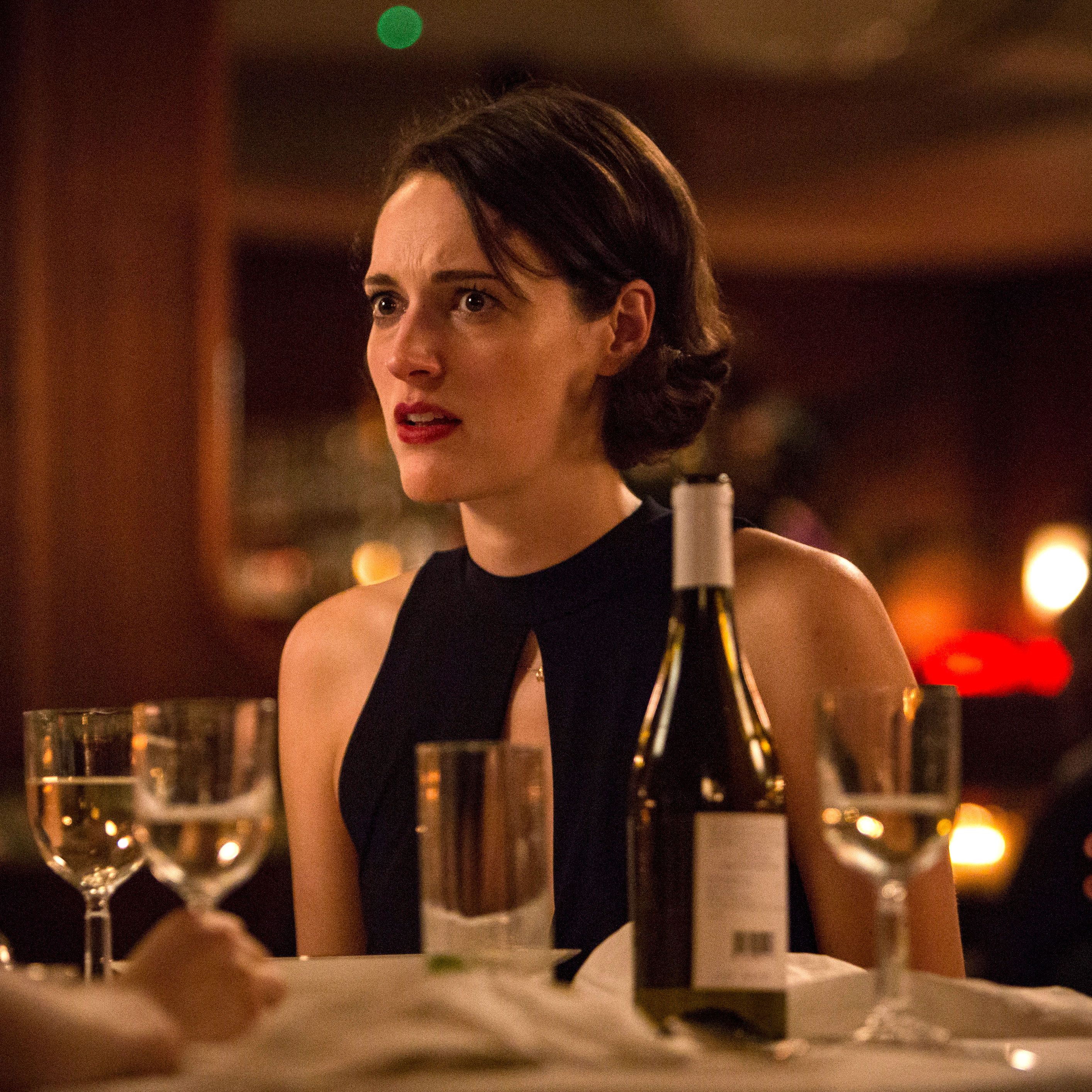
At the end of episode five in the second series of Phoebe Waller-Bridge's hit show Fleabag, the audience finally gets what they've been waiting for: The Priest and Fleabag, having sinful sex at last.
Only, as Fleabag pushes the camera away, it turns out that for once this is fornication we're not allowed to see.
Throughout the series, we've been privy to her sexcapades – there's the Hot Misogynist who made her come nine times, Harry, who didn't make her come at all, and who could forget Arsehole Guy, who inspired series one's memorable opening monologue on the perils of anal sex? But this – this is private.
What to Read Next

This pivotal moment brings together two of the most debated questions in the series so far: what will become of their will-they-won't-they relationship, and just who is Fleabag talking to when she looks at the camera?
Now we have one of those answered, it's only made the other more complicated. With all the sexual tension finally dispersed, let's take a look at who could be on the other end of those camera confessions.
She’s talking to us
In season one, it feels fairly obvious that it is the audience who Fleabag is addressing. A show's main character breaking the fourth wall is a well-worn narrative trope but instead of just providing context, this time it's also a conduit for dramatic irony.
Fleabag is a comedy tangled in great darkness – mental darkness, sexual darkness – and these fourth wall moments, which occur with noticeable frequency, bring the shadows to light. Whether it's her sexual desires or her deepest feelings, without this window to her soul, we would have no sense of who Fleabag really is.

Or who anyone is, for that matter; this quintessentially British show has bred quintessentially British characters – stoic, enigmatic and yearning to stay unemotional in the face of adversity.
So when, in season two, we witness her catching feelings for The Priest, there becomes something – ahem – holy about the first time they have sex. For the first time in our relationship with the main character, she's not willing to show us this intimate side of her. While we've had fleeting glimpses into her darkest desires, there are certainly times, like this, that she hides from us in plain sight.
Because we're not friends. Not really. Not like she says we are. Most of the time, any genuine audience intimacy with Fleabag has been a mistake.
Mostly, she speaks with us matter-of-factly, even when it comes to the sad details. But when, for example, we find out she is the one who slept with Boo's boyfriend in the climax of series one, she can barely look us in the eye.
Could these moments signify that Fleabag doesn't trust us as much as she makes out, or is it something else?
It's a manifestation of her poor mental health
What we quickly learn about Fleabag is that she's an unreliable narrator. Yes, she may speak honestly of her most primitive desires but when she's breaking the fourth wall we're not always confronted with the truth. She misleads with significant omissions and incorrect impressions of people.
She doesn't know those closest to her like she thinks she does – she's convinced that her sister Claire won't eat birthday cake, and that her ex Harry will come back to her, but of course they defy her expectations.
She's lonely and grieving but in denial about almost everything, and her soliloquies often feel more like an attempt to convince herself. She can't admit the things she needs to confront the most, like the part she played in Boo's death, and so when the big reveal comes at the end of series one, averting her eyes from the camera could instead indicate that she can't face up – quite literally – to her guilt or her grief.

As such, we learn to take everything Fleabag says with a pinch of salt. Her words drip with such sardonic wit that it's only when they're repeated back to her nearly verbatim by a therapist that you can hear the harsh reality of what she's actually saying.
When asked by this therapist (played brilliantly by Fiona Shaw) about friends, Fleabag is assertive that she has people she can talk to. "They're always there," she says, locking eyes with the camera. "They're always there."
Is she talking about Boo? Is what's beyond that camera a manifestation of her guilt that she just can't shake? If this is the case, The Priest's innate ability to sense Fleabag's introspection likely indicates that he sees her in a way no one else does.
She's talking to Boo
Strip the show down to its most basic elements and Fleabag is looking into the camera because she is the narrator of this story.
In that sense, she should be the only one that does. But there are obvious visual clues that tell us we aren't actually her audience – Boo is.
Her best friend is the only other person who looks directly into the camera, the same way Fleabag does. A fleeting image of her shaking her head to camera whilst eating a sandwich convinces Fleabag not to open up to the The Priest about who Boo is.

During another flashback at the funeral of Fleabag's mother, Boo talks to the camera as if she were looking at our narrator herself – it's almost Peep Show-esque. At one point during the funeral, both Claire and Fleabag look into the camera with disdain after speaking to their Godmother, because at this point, Boo is still alive and so they can both see her.
In the scenes where Boo is in shot, Fleabag looks to her instead of at the camera.
If this is indeed the case, then the kind of camera confessions Fleabag gives in season one ("Boo’s death hit the papers: 'Local Cafe Girl Gets Hit By Car'.") cease to make sense. But in the context of season two, and specifically The Priest's plot line, it works.
It figures that he can sense when Fleabag is talking to her dead best friend – his connection to the spiritual and his belief in the afterlife could be what allows him to tune into their (one-sided) correspondence. And it wouldn’t be the first instance of some kind of divine intervention. Thanks to God's apparent disapproval of their 'unholy communion', The Priest has a lot of paintings to hang back up.

When Fleabag and The Priest finally sleep together at the end of episode five, it feels like her instinct to push the camera down could be an attempt to push down her guilt. This means something to her. But is she allowed to be happy? Is she allowed to enjoy sex and feel love after what she did to her friend?
To Fleabag, her bliss feels like the ultimate betrayal.
Breaking the fourth wall is not new. Shakespeare's characters often speak in soliloquies and Aristophanes believed the fourth wall was meant to be broken. But there's something utterly unique about the way Waller-Bridge uses it to elevate Fleabag's story.
Rarely does the audience want such a heightened sense of awareness of the part they play in a plot, but the ambiguity surrounding our role in Fleabag's narrative makes this the most intriguing show on screen right now.
Want up-to-the-minute entertainment news and features? Just hit 'Like' on our Digital Spy Facebook page and 'Follow' on our @digitalspy Instagram and Twitter account.