First released: 1999 (PC)
Now Available On: PC
It seems appropriate that a new entry in the RollerCoaster Tycoon series is due to be released the same year the PC classic comes of age.
Developed by MicroProse and Chris Sawyer in 1999, RollerCoaster Tycoon turns 16 years old on March 31 and we can't think of a better excuse than that to strap ourselves in for another ride.


The game cast players as theme park entrepreneurs and had them contend with preset scenarios related to the construction and management of virtual theme parks.
As you can probably tell from the title alone, the game placed a particular emphasis on white-knuckle rides, but other attractions, including log flumes, carousels, bumper cars, haunted houses, go-karts, and ferris wheels, could also be built.
The key to a successful theme park in RollerCoaster Tycoon was providing diverse attractions, particularly as players had to cater for visitors of all nausea-tolerance levels.
What to Read Next
Keeping your guests happy was imperative and their collective mood was dependent on more than just the quality of the attractions.
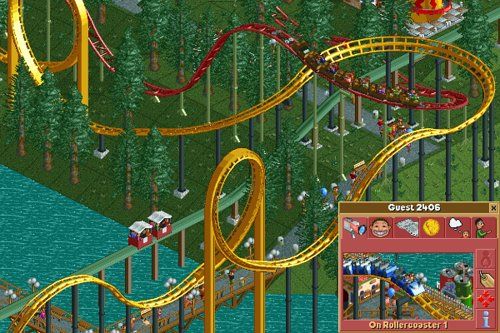

Players were responsible for hiring handymen to keep the park clean and tidy, mechanics to ensure rides remained in working order, security to prevent vandalism, and entertainers to engage with visitors when they weren't hurtling around a corkscrew at 130 miles per hour.
It was also possible to manipulate the geography of the park, lowering and raising the terrain to accommodate rides and adding water features to improve aesthetics.
Items like food stalls, information kiosks and bathrooms had to be strategically-placed to ensure visitors were given easy access, keeping them content and your park's approval rating up.
It was also important to build pathways between your attractions, otherwise guests would wander around aimlessly until they became bored, or fell into one of the water features and drowned.


One of RollerCoaster Tycoon's most memorable features, however, was the option to design your own roller coaster using a tile-based construction system.
Players could determine the speed, height and gradient of their ride, as well as add features such as zero-gravity rolls, corkscrews, vertical loops, and on-ride photos.
Custom-built roller coasters had to strike a balance between achieving a high thrill level with as little nausea inducement as possible, while also putting safety first.
Failure to recruit an appropriate number of maintenance staff usually resulted in your attractions breaking down, while poorly-designed rides were prone to collisions and derailment, often fatal to your guests and your park's reputation.


RollerCoaster Tycoon launched with 21 scenarios, most of which tasked the player with revitalising a dilapidated park, while others had them build one from scratch.
Victory conditions included reaching a visitor milestone and building your park up to a specific value. When these were met, new scenarios were unlocked.
The original RollerCoaster Tycoon received two official expansion packs during its life cycle - 'Added Attractions' and 'Loopy Landscapes' - both of which were meaty add-ons containing another 30 scenarios each.
Both packs were included in the RollerCoaster Tycoon Deluxe compilation, which also offered additional parks based on real-life ones, including Blackpool Pleasure Beach - in keeping with the theme of putting the player in charge of a worn out old husk.
In 2003, Frontier Developments and Infogrames teamed up to bring the game to Xbox. The console edition was considered a solid port, but was criticised for being a light on new features.


The PC original received glowing reviews from fans and critics at launch, and was followed by two wildly successful sequels, the third instalment receiving plaudits for introducing the much-requested sandbox mode.
Unfortunately, the series strayed off track spectacularly when it made the jump to handhelds in 2012 with the release of RollerCoaster Tycoon 3D on Nintendo 3DS, a game that failed to live up to its PC predecessors.
Last year's RollerCoaster Tycoon 4 Mobile saw the franchise slump to a new low, with costly microtransactions, excessive loading times and missing features making it more nausea-inducing than any of the rides it depicts.
However, these missteps shouldn't tarnish one of the greatest PC games of its generation, and if the upcoming RollerCoaster Tycoon World turns out to be the game fans are hoping for, they will quickly become distant memories.


