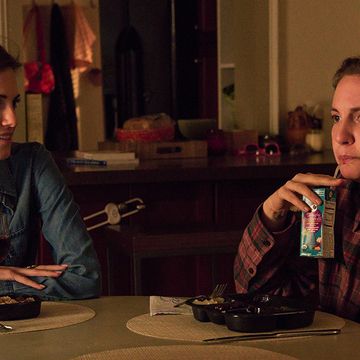
"A friendship between college girls is grander and more dramatic than any romance." So ran the first line of Hannah's doomed e-book back in season two of Girls, and though she never got to finish the thought, it's this sentiment that lies at the core of the show. The grand dysfunctional romance between Lena Dunham's Hannah and her best friend Marnie (Allison Williams) was one of several plot strands that fell somewhat by the wayside last season, but it's back in focus here as Hannah's departure for Iowa puts all her relationships under the microscope.
The opening episode of the fourth season, which takes place over Hannah's final two days in New York, ends on an unusually heartfelt note as Marnie shows up at the crack of dawn to say goodbye. But as with any such moment on Girls, it's bittersweet and spiky and comes with the acknowledgement that both girls are raging messes - particularly Marnie, who's still sleeping with her musical partner Desi behind his girlfriend's back. Her only concern about the situation is not wanting to be seen as his mistress. So when - like clockwork - another moment of public musical humiliation arrives for Marnie in the first episode, you can't help but feel she deserves it despite Allison Williams' beautiful voice.
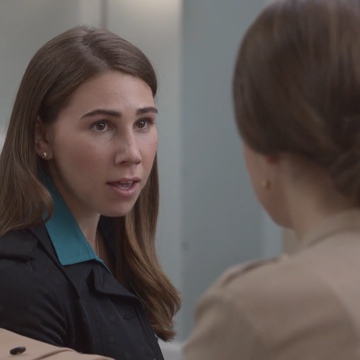
There are laugh-out-loud (and cringe-out-loud) moments aplenty here, starting early on with a brilliantly earnest antidepressant commercial in which Adam (Adam Driver) has ended up starring post-Broadway. But these first episodes are all noticeably warmer and less arch than season three's early going, with the show's ensemble cast being more evenly served. Hannah spinning off into her own storyline at writing school in Iowa leaves more breathing room for the remaining Girls back in Brooklyn, with Shoshanna (Zosia Mamet) given a coherent character arc again as she struggles with post-graduation job hunting, and Jessa (Jemima Kirke) more compelling than she's ever been thanks to being paired with fellow recovering addict Adam.


Although Hannah is written as Michigan-born, Dunham is a New Yorker through and through, and the show is tangibly less at ease in its new Iowa setting than back in the city (for financial reasons, all of the Iowa locations were shot within New York State). The depiction of midwestern life is broad in ways that only sometimes feels intentional, but it's the depiction of her writing programme that really rankles - her fellow students play more like meta embodiments of Dunham's real-life critics than believable human beings, and Hannah's responses to them are equally cartoonish.
Overall though, season four feels like Girls maturing and re-focusing along with its characters, mining its established universe for both comedic and emotional material rather than relying too heavily on guest stars. Ray's multi-episode obsession with a malfunctioning traffic light on his street is a sheer joy, as is his reignited (but platonic) relationship with an older, wiser Shoshanna. Andrew Rannells's reliably hilarious Elijah is the kind of character you can easily imagine wearing thin with overuse, but despite his promotion to series regular he's pitched just right in these episodes.


Girls is growing up, and as if to prove it the season's first episode begins on a scene that mirrors the very first moments of season one, with Hannah sharing a very different kind of dinner with her now-proud parents. The season's midpoint episode is a startlingly raw heartbreaker, bringing Hannah together with all five of her co-stars in turn for a series of interactions that are variously funny, surreal, unexpectedly touching and utterly original. Dunham's remains a genuinely unique voice in a TV landscape that needs more like her.

Emma Dibdin is a freelance writer based in Los Angeles who writes about culture, mental health, and true crime. She loves owls, hates cilantro, and can find the queer subtext in literally anything.