As Britain digests the results of its General Election, a look back at some of the most memorable prime ministers from TV and the movies reveals a bunch only marginally more disconcerting than some of the real-life options.
Operating on a scale from complete idiocy through to full-blown murderous villainy, were they actually on the ballot paper, you'd probably do well to think twice before putting an X in their box. But you can be sure of one terrifying thought - someone out there would.
So who would you vote for, given the choice between the real prime minister and 8 of TV and film's most memorable premiers? Find out more about our fictional candidates below...
1. Baldrick in Blackadder: Back and Forth

Baldrick became an MP in a rotten borough during the opening episode of Blackadder the Third, mainly thanks to the help of a campaign partner who's especially keen to deal with all the necessary paperwork in the ever-nefarious Edmund. But Blackadder's trusty aide fails him by proving a little too susceptible in Parliament. Then, due to numerous clerical errors, he somehow ends up in the House of Lords having spent six figures of Edmund's cash not on backhanders, but a giant turnip. At least that shows he's got a bit of integrity.
However after he accidentally builds a working time machine, Baldrick finally makes it to Number 10 the easy way as Prime Minister in the turn-of-the-millennium special Blackadder: Back and Forth, having dissolved Parliament two years previous and maintaining a "particularly close" relationship with the surprisingly popular monarch King Edmund III.
What to Read Next
Leadership qualities: There's a resourceful, creative and ingenious brain behind that unassuming exterior. I mean, who else would have thought of rewriting time to secure a fifth consecutive term in office?
Weak spot: Baldrick's 'cunning plans' do have a tendency to backfire at the most inopportune of moments - and we all know who's really pulling the strings behind the scenes.
2. Harold Saxon in Doctor Who
Okay, okay, we know what you're thinking. Harold Saxon wasn't a real man, so much as a sharp-suited, Oxbridge-educated fabrication created in order to allow a supervillain to take over the Earth. And that's bad. But we'd still vote for him over Nigel Farage.
Saxon served as a high-ranking official at the Ministry of Defence for more than a year before becoming PM, and accomplished plenty during his brief tenure – he funded a spot of research into immortality, and laid the groundwork for his eventual world domination by setting up the Archangel telecommunications network, which would ultimately allow him to telepathically control all of humanity.
He's strong on foreign policy and intergalactic relations too, in the sense that he successfully recruits the Toclafane as allies once he ascends to power and enslaves the Earth.
Leadership qualities: You can't deny that Saxon knows how to put a plan into action, and his campaign strategy is the stuff of dreams for most real-life politicians (telepathic control of the entire human population?!). He's a pretty compelling candidate if you turn a blind eye to his policies.
Weak spot: The megalomania and sadism are stumbling blocks. The Scissor Sisters obsession is a deal breaker.
3. Alan B'Stard in The New Statesman
After seven years of devious political ladder-climbing, sexual misadventures and unashamed personal promotion, the late, great Rik Mayall's Tory-turned-Labour MP finally had the experience to run the country by the final episode, making Britain his "plaything" and declaring himself Lord Protector.
Leadership qualities: Not afraid of getting his hands dirty, be it sabotaging the vehicles of his competitors or assassinating world leaders that won't play ball, B'Stard manages to bat away bad PR with a grin and a gag, always looking damn attractive while he does it. He sued The Times and won, too, so would be more than happy to make like Miliband and stick it to Murdoch.
Weak spot: The ultimate elitist and hater of the working class - even suggesting the outright closure of the NHS - and with a memorial graveyard of skeletons in his closet, that PR machine would have to work overtime in the social media age. We can't imagine B'Stard's beyond lavish spending is a good fit for Britain right now, either. Still, beats austerity…
4. Jim Hacker in Yes, Prime Minister
"I'm just checking to see it wasn't April 1st," Bernard quipped when sounded out about the idea of Jim Hacker as PM by Sir Humphrey. But after three years of defeats punctuated with rare successes at the Department for Administrative Affairs, Hacker found himself manoeuvred into the top job in Yes Minister 1984 special 'Party Games'.
He may have only got the job because of the Chancellor's strange sexual proclivities and Foreign Secretary's financial indiscretions, but Hacker showed some rare cunning and killer instinct to win the top job, and it felt like a victory for us too - especially as we got two great series of Yes, Prime Minister as a result.
Leadership qualities: Not many traditional attributes for a leader, to speak of, but nothing can stop Jim when he goes into full Churchill mode, hand-in-waistcoat. And that ability to keep your head down, keep your nose (mainly) clean and hang around long enough until you somehow eke your way to the top is a template many in politics have followed.
Weak spot: Hacker is weak, vain, pompous, silly and self-regarding. He puts party ahead of country and himself ahead of party. He would rather have six column inches in The Daily Telegraph than make any real impact on the country. He likes a drink. He's a former editor of Reform who, by the time he reached Number 10, has sold out pretty much every principle he held dear. He's a little guy with the good heart stuck in a Kafkaesque nightmare of the biggest job with no real power. He's one of us.
5. Michael Callow in Black Mirror
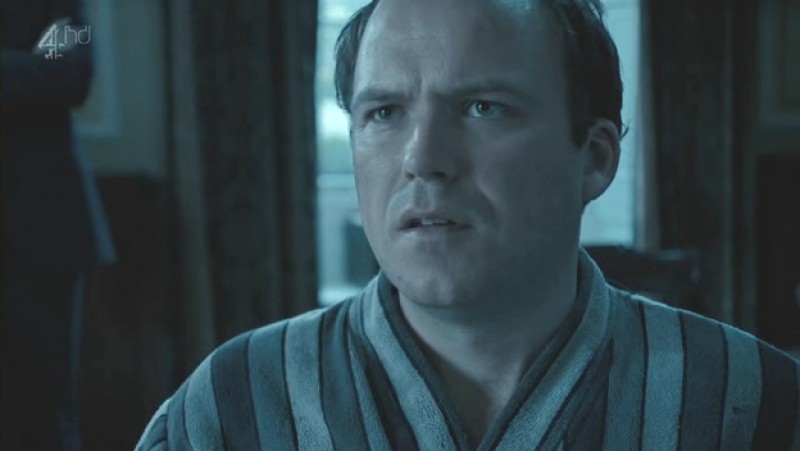
Played by MI6's friendly faced chief of staff Bill Tanner (or Rory Kinnear to those committed to the real world), those other-life years with Bond have made Callow just the right PM for Charlie Brooker's bleak near-future, and ours: stoic, sceptical and with an innate distrust of social networks.
Leadership qualities: Callow is calm in the face of mounting pressure, a man of action, loyal to his people, willing to make genuine personal, as well as political, sacrifices and is, erm, kind to animals. He even manages to turn a kidnap of a princess on his watch and his enforced sex with a pig into a political win – we challenge Cameron or Miliband to grow their public support under such circumstances.
Weak spot: His unfailing dedication to the royal family is sure to divide Britain, while his staff are the very definition of bumbling, but more importantly there's the nagging fear that if he's able to be duped by a Turner Prize winner into bestiality on global TV, what could international heads of state get him to do if they put their mind to it?
6. David in Love Actually
Regardless of how you feel about Hugh Grant, it's pretty hard not to enjoy Love Actually's affable, newly elected bachelor of a Prime Minister.
On his first day in Number 10 his priority is finding a cup of tea and a chocolate biscuit, which inherently makes us understand and trust him, and he's not afraid to groove out to a little Girls Aloud. (That iconic dance scene is made so much better by the knowledge that Grant himself didn't want to shoot it, having pushed for the PM to be a more grounded character.)
We can take or leave his vaguely regressive relationship with Martine McCutcheon's tea girl, and we're admittedly not sure when he gets time to actually run the country amidst all these distractions, but his sister is Emma Thompson and that pretty much gets him a vote alone in our book.
Leadership qualities: He's an all-round nice guy, which is sort of like finding a unicorn in politics, and he knows how to connect with everyday folks in "the dodgy end" of Wandsworth.
Weak spot: The occasional tendency to make politically disastrous speeches on public television which effectively sever the UK's special relationship with America. Then again, Tony Blair singled this out as the aspect he found hardest to live up to in real life, so what do we know?
7. Francis Urquhart in House of Cards
Before Frank Underwood was pacing Capitol Hill plotting the downfall of his enemies, Francis Urquhart was doing his best to prove the old theory that "power corrupts, and absolute power corrupts absolutely". The more power he gets, the more terrifying and dictatorial Francis becomes, earning people's trust and then breaking their spirit.
Whether it's making the king abdicate or pushing your ex-lover off the roof of the House of Commons, no scheme is too much for over-the-top Francis, played to perfection by the drama's BAFTA-winning star Ian Richardson. He should be deeply unlikable but even manages to seduce the viewer, inviting you into his world with false modesty, an eloquent turn of phrase, little asides outlining his dastardly plans - and, of course, the odd Shakespeare quote, to magnify those Macbeth and Richard III comparisons even more.
Leadership qualities: Complete command of the media, his party and his opponents. Francis keeps his friends close, his enemies closer and his closest friends rather too close for their own comfort. As a former chief whip in the House of Commons, he's not afraid of "putting a bit of stick about" (his words, not ours) either.
Weak spot: Oh, we couldn't possibly comment. Actually, we could - just the high-minded 'FU' attitude, a casual indifference towards blackmail and bribery, emotional manipulation of his wife, his close friends and numerous lovers, the ultra-conservative authoritarian policies... Oh, did we mention the fact he always seems to be murdering people?
8. Michael Stevens in Little Britain
Channeling Tony Blair in fine style, Anthony Head plays a likeable and suave PM that somehow got lumbered with a very protective secretary named Sebastian Love, camped up to the max by David Walliams. Sebastian will stop at nothing to display his love for the PM, and we really do mean nothing.
Leadership qualities: Michael can easily charm whoever he has dealings with to get what he wants, though this may prove to be a fault as it appears everyone eventually falls in love with him. But, who can blame them, it is Giles from Buffy, after all.
Weak spot: He doesn't seem to have the best awareness skills, appearing oblivious to Sebastian's advances for years. He also isn't able to say no very easily, which isn't the best quality for a PM. He's also a bit of a cad, apparently having affairs left right and centre, including even the President of the United States.
By Matt Hill, Emma Dibdin, Mayer Nissim, Kate Goodacre and Tom Eames