Pachinko episode 7 spoilers follow.
Given all the acclaim that Pachinko has (rightly) received, you might be surprised to learn that showrunner Soo Hugh wasn't convinced that an adaptation was even needed at first.
"I read the book, and I found it so extraordinary," says Hugh. "But I don't think every book needs to be adapted into TV or a movie, right? If the book is extraordinary, read the book. The only reason to do an adaptation and give it cinematic life is if you feel like you're going to do something… If you're going to bring another life to it."
Soo struggled to "figure out the book" in that sense, to the point where she felt no longer fit to tackle this project. "I was like, 'I don't think it's a TV show. I don't think I can do it. I'm not the right person for this.'"

But then, inspiration struck. "Why tell it linearly?" Hugh wondered. "What happens if you make this a dialogue between the past and present?"
Suddenly, all the pieces of Pachinko's intergenerational saga fell into place. "I knew what the show was, once I figured that out. And that was really exciting to me."
What to Read Next
By weaving the past and present together in such a mesmerising, almost dreamlike way, Soo makes familial links tangible across countless miles and even decades.
The trauma and isolation that each character endures is made even more impactful by this tender reframing of the source material, yet, counter-intuitively, the most moving episode of all actually finds its strength by breaking away from that approach.
Unlike the rest of Pachinko, episode seven halts the timeline-hopping in favour of something more straight and linear. "We always said that episode should feel like a standalone film by itself," says Hugh, which it does, and not just because of its smaller time-scale.
Chapter Seven is epic in a very different way to the rest of the show, and the trauma it explores is far more visceral and immediate than anything seen in the other episodes too. That's because this extraordinary hour of TV hones in on the real-life tragedy of Kanto's 1923 earthquake, along with the massacre of countless Koreans that followed.
When it hit on September 1, 1923, the Great Kanto Earthquake set off a chain reaction of natural disasters that devastated Japan even more beyond that initial, deadly jolt (info sourced from The Smithsonian Magazine).

Just a few minutes later, a 40-foot high tsunami swept away thousands, and then fires soon followed, which burned through the wooden houses of Yokohama, and even Tokyo. Near Tokyo's Sumida River, people desperate to escape were killed by a freak pillar of fire known as a "dragon twist".
Overall, the death toll landed at around 140,000, and that also includes the 6,000 or so Korean immigrants who were murdered in the immediate aftermath of the earthquake.
Tensions had been running high for quite some time before then, ever since Japan occupied Korea in 1905. So amidst the chaos of this awful tragedy, rumours quickly spread that Korean people were poisoning wells and plotting to overthrow the government. In retaliation to these clearly unfounded ideas, groups of Japanese people began to roam the earthquake zone and kill any Korean immigrants they encountered.
Pachinko explores this day in what feels like real time, taking us through the earthquake as well as the murders that followed. But what's particularly interesting about this one-off episode is that none of this was actually featured in the original source material.
Most of season one is extremely faithful to Min Jin Lee's work, aside from the timeline shuffling, but Soo realised that incorporating the Great Kanto Earthquake could help "bring another life" to her adaptation – and especially one character in particular.
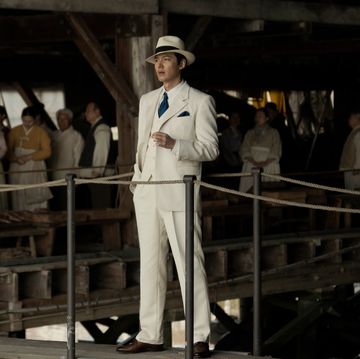
"There are so many questions about Hansu, right? In the writers' room, it was: 'who is he? Where did he come from? Where did this armour that he has – how is that built?' And then it was like: wait a minute, let's just answer those questions. 'Why not?'"

"And in my research, I came across the Kanto Earthquake," Hugh continues. "I didn't know about what happened to the Koreans afterwards. And the year 1923 – the lightbulb went off. You're like, 'Oh my God, this is it. This is where he came from. This is what he saw.'"
"Because then it explains… When you see that kind of horror, how can you not change? How can your life not go on a different course?"
Pachinko doesn't shy away from that horror. Through the eyes of Hansu, we see the visceral impact of the earthquake firsthand, and crucially, the Korean massacre that followed too.
As Soo herself admits, a lot of people remain unaware of that painful aftermath, so it's doubly impressive that this chapter can shine a vital light on that while also giving Hansu the extra backstory he needs.
"Hansu is difficult to perfectly understand up until episode seven," says actor Lee Min-ho, "because he acts in certain ways, and he speaks in certain ways that people might not feel very good about.
"So in that regard, I think that episode seven has great importance, because only when people watch it can they really understand why he speaks in a certain way, and why he acts and makes decisions in a certain way."
Soo tells us that she deliberately chose to film this episode with "an old, cinematic ratio, 4:3," instead of the regular 2:35 widescreen because "we didn't want to portray the devastation in an aesthetically beautiful way."
The goal was to convey Hansu's sense of claustrophobia in the face of something overwhelmingly powerful and deadly. "In order to really get into the horror of what happened, we wanted it to feel very contained," adds Hugh.
And yet, by inviting us into Hansu's trauma firsthand, Chapter Seven also reframes his relationship with Sunja too, opening him up in ways far less contained.

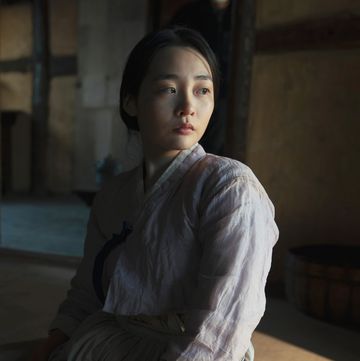
"I personally remember the scenes where I was at the cliff with Sunja," says Lee Min-ho. "Where she cleans her clothes. There, Hansu talked about his past and his childhood.
"I think that moment was an emotional healing for me. Because for Hansu, he kept his past and his childhood hidden from everyone, and it was something he didn't really look into. But through Sunja, it was the first time that it kind of broke loose, and he really talked about his childhood and his past."
This circles us back around again to the notion that Soo needed to "bring another life" to her take on the novel. And she absolutely succeeded in that goal, not just with Hansu's tragic backstory, but also with the wider story of how this earthquake impacted real-life Korean immigrants too.
Looking back, it's now impossible to imagine the story of Pachinko without it.
Pachinko airs weekly on Apple TV+.
Best Entertainment and Tech Deals


Coronation Street X Joanie - Gilroy Retro Newton And Ridley Sweatshirt












After teaching in England and South Korea, David turned to writing in Germany, where he covered everything from superhero movies to the Berlin Film Festival.
In 2019, David moved to London to join Digital Spy, where he could indulge his love of comics, horror and LGBTQ+ storytelling as Deputy TV Editor, and later, as Acting TV Editor.
David has spoken on numerous LGBTQ+ panels to discuss queer representation and in 2020, he created the Rainbow Crew interview series, which celebrates LGBTQ+ talent on both sides of the camera via video content and longform reads.
Beyond that, David has interviewed all your faves, including Henry Cavill, Pedro Pascal, Olivia Colman, Patrick Stewart, Ncuti Gatwa, Jamie Dornan, Regina King, and more — not to mention countless Drag Race legends.
As a freelance entertainment journalist, David has bylines across a range of publications including Empire Online, Radio Times, INTO, Highsnobiety, Den of Geek, The Digital Fix and Sight & Sound.