
Release Date: April 1 (Europe), March 31 (North America)
Platforms Available On: PS4 (PC, Vita coming soon)
Developer: Thomas Happ Games
Publisher: Thomas Happ Games
Genre: Adventure
The name of adventure game sub-genre 'Metroidvania' is a dirty word. Never mind that most of the Castlevania games don't even fit the traits associated with the term, the jargon portmanteau between Konami's series and Nintendo's Metroid has become a bit of a lazy shorthand for describing an incredibly rich and complex gaming genre.
And then in swoops Axiom Verge, a game both structurally and aesthetically so evocative of Metroid that comparisons to Nintendo's space bounty hunter are practically inevitable. Perhaps a part of me even wanted to resent the game simply for dredging the term back up into relevancy.
But after spelunking through Axiom Verge's vast map of caves and alien complexes, I've grown to respect the game far too much on its own terms to let it be dismissed with the jargon that shall not be named.


Axiom Verge begins with a bang, quite literally. Players are introduced to Trace, our mop-haired scientist protagonist, just as he is caught in the middle of a massive explosion that levels the research laboratory where he works.
The very next moment, Trace finds himself emerging from a giant egg-shaped contraption in an environment that is alien in every sense of the word.
What to Read Next
The jarring shift immediately establishes a sense of unease and isolation that permeates throughout the rest of the game. Even a voice calling out to Trace offering assistance is initially tinged with ominous intent without any frame of reference for what should be expected from this strange world.
It utilizes curiosity as a gameplay tool, making it feel like each new corridor you uncover is a small victory against the alien environment that had previously blocked your path.
While Trace quickly finds a weapon and players set about using it to fight the various alien enemies they encounter, the real battle at the core of Axiom Verge is one between the familiar and unfamiliar.
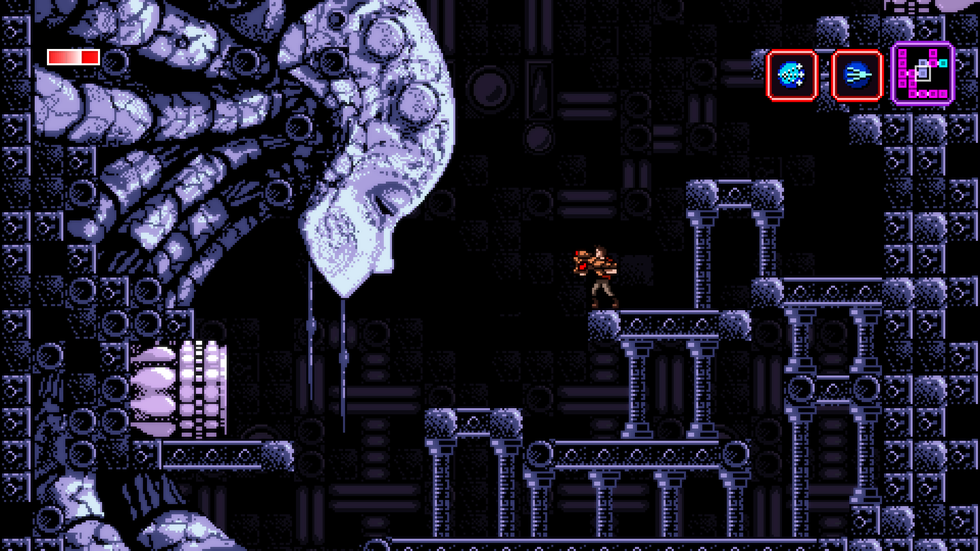
The world of Axiom Verge is an expansively branching and interconnected series of corridors and caverns.
There is a map you can consult to avoid getting lost, but instead of highlighting where to go next the map's Spartan presentation simply tapers off into a void for areas you haven't visited yet.


While the map tactfully pushes you to explore Axiom Verge's world, it is a gated exploration where many paths result in dead ends with a ledge just out of reach or door blocked by an impassible barrier.
But the more you explore, the more you will accumulate tools and abilities ranging from increased jump height to a drill that can cut tunnels through solid rock to help you overcome dead ends and environmental obstacles.
However, none of Axiom Verge's tools are quite as extraordinary as the disruptor, or as I prefer to call it, the glitch gun. While it has uses in the environment to open new routes, the glitch gun's beam also works on enemies, and produces a unique effect depending on the alien being targeted complete with a glitched, static-covered appearance and altered attack behaviours.


Some glitched enemies become harmless while others become twice as deadly, again feeding into the game's dichotomy between the familiar and unfamiliar. And with the glitch gun players can begin to fight back, experimenting and learning how enemies are affected and turn the potential danger of the unknown into a familiar tool that can be exploited.
These "aha!" moments - when you realize a newly acquired item is the perfect key for breaking a wall or reaching a ledge that was just out of reach - is the momentum at the core of gated exploration games like Axiom Verge.
It utilises curiosity as a gameplay tool, making it feel like each new corridor you uncover is a small victory against the alien environment that had previously blocked your path.


This compulsive system of gated exploration, where new abilities allow you to explore further and discover even more abilities, isn't exactly unique to Axiom Verge. However, Axiom Verge's world has been cleverly laid out to mitigate the need for constant backtracking that typically bogs down the pace in similarly structured games.
That isn't to say backtracking has been eliminated. The game is packed with secrets to uncover by revisiting old areas with new abilities. Even at the point where I have explored 95% of the map, the game tells me that I have only found 75% of its items.
The truth of the matter is that its blemishes stand out so strongly in large part because of how thoughtfully designed and well executed Axiom Verge is overall.
But to find the key items and abilities needed for expanded exploration, the path is almost always found by pushing forward rather than doubling back into familiar territory.
As a fantastic side-effect of the game's constant forward momentum, the rare occasion where a new path reconnects with an older region of the map becomes a cause for celebration. After fighting your way through the unknown for so long, that small hint of familiarity makes even an alien landscape filled with foreboding the first time you passed through it feel like finally coming up for air after a long swim.

Unfortunately, while maintaining a sense of mystery makes exploring Axiom Verge's world more exciting, the same can't be said for the game's story. Axiom Verge seems to have a rich backstory behind it written in notes and journal entries spread across the map. Creating an over-complicated and jargon-filled web of plot that only seems to raise more questions than it answers.
The game's push for exploration doesn't always pan out the way it should either. At two points in particular all progress seemed to grind to a halt, and after speaking with some other reviewers I found that others had also been caught off-guard at exactly the same points.
These occasional show-stoppers aren't nearly as egregious a flaw as Axiom Verge's final boss battle though, which atrociously revolves around taking unavoidable damage and praying for random health drops. Axiom Verge doesn't trip up often, but when it does it falls down hard.
Of course, the truth of the matter is that these blemishes stand out so strongly in large part because of how thoughtfully designed and well executed Axiom Verge is overall.


The gated exploration at the core of games like Super Metroid or Cave Story is distilled to its most potent form in Axiom Verge, and in a way that industry jargon could never do it justice.
Where jargon would hide Axiom Verge's thick atmosphere, inventive equipment and well-paced exploration under the umbrella of 'Metroidvania', doing so ignores the room for improvement and growth even in a well established game formula.
Regardless of what label you end up applying to Axiom Verge in your own discussions, the most important one to keep in mind is this: Axiom Verge is a damn fine game.









![Chris Hemsworth Bad Times at the El Royale dance [gif]](https://hips.hearstapps.com/digitalspyuk.cdnds.net/18/41/1539256413-chris-hemsworth-bad-times-el-royale-dance.gif?crop=0.4074074074074074xw:1xh;center,top&resize=360:* "Chris Hemsworth Bad Times at the El Royale dance [gif]")