The Nintendo rumour mill apparently had a town meeting last night, as multiple reports broke out that the 3DS and Wii maker's next console, codenamed Nintendo NX, would not only be a standalone portable gaming device that can also plug into your telly, but one that has detachable controllers, too.
While unconfirmed by the big N as yet, these details are entirely believable for two reasons:
a) With Nintendo's handheld business its mainstay and Pokémon Go the biggest thing to happen to it in years, basing an uncertain future around portability rather than an arms race with PS4 and Xbox One is pretty sensible.
b) Nintendo has done this exact thing before – and it's ALWAYS recycling its old ideas.
Let us count the ways the retro-obsessed game firm has repackaged itself in the name of giving Mario a new lease of life…
1) Nintendo NX (2017) / Game & Watch Micro Vs (1984)
What to Read Next
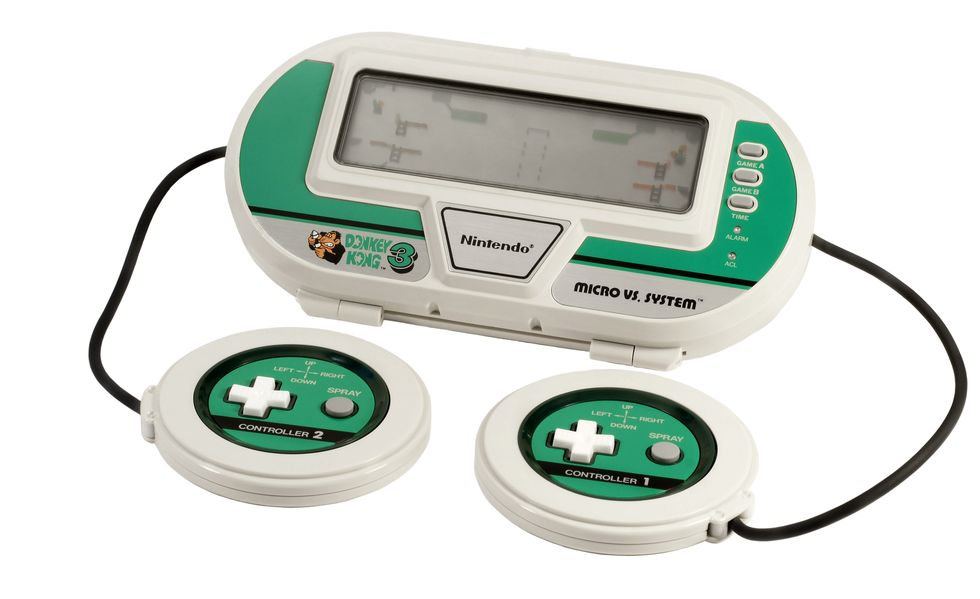

The concept of the NX sure looks and sounds like the Game & Watch Micro VS system (above) given a reboot for the iPad age, trading wired-in mini-controllers (that were wound up and housed inside the device) for modern, swanky Bluetooth ones.
Even the detachable joypads on either side of the NX's supposed sketches are reminiscent of the arrangement on Nintendo's original Famicom…

2) Nintendo DS (2004) / Game & Watch Dual Screen (1982)
The most obvious and successful direct reboot and an undeniable design classic, the Donkey Kong Game & Watch handheld was the first dual-screen, flip-top Nintendo portable.


It also brought the D-pad four-way control input into the world, which Nintendo would go on to use on every machine it's made since.
3) Duck Hunt (1984) / Konsenju Duck Hunt (1976)


Our beloved Duck Hunt didn't arrive fully formed into our world with the NES Zapper and laughing dog in tow, oh no – it was actually based on a far more physical game of the same name that Nintendo made in the '70s when it spent a lot of its time making electro-mechanical ideas for plastic guns.
The concept was basically the same but you shot at a series of projected images of ducks on your wall (projector included in every box!) rather than on your TV.
Nintendo pulled the exact same trick with Elijah Wood's favourite western-themed game, Wild Gunman, the same year…
… another successful '76 Konsenju toy line Nintendo reinvented for the NES's launch window.


4) Game Boy Micro (2005) / Game & Watch (1980)
This squished-down, remodelled Game Boy Advance got more mileage out of the GBA format by adding a backlit screen to an instantly recognisable silhouette (with added, now-ubiquitous D-pad).


5) Virtual Boy (1995) / Game & Watch Tabletop (1983)
The biggest, reddest failure of them all, this early dive into "VR" (quote marks for de-emphasis) was a table-top plastic box you stared into that gave an interesting visual effect that no one else could see – something Nintendo had already tried with its arcade cab-style take on Game & Watch more than a decade earlier.


In a knock-on effect of Nintendo's ongoing design evolution process, the unwieldy Virtual Boy controller was also clearly slimlined and refocused for the next year's Nintendo N64, before being further tweaked for the GameCube five years later.
6) Super Nintendo US (1991) / Famicom (1986)
Design nod or just sticking with success, Nintendo based the US version of its 16-bit Super NES console very heavily on its original Japan-only Famicom console, all utilitarian rectangles, no rounded edges and prominent dual front switches.


Of course, it had formerly redesigned the basic Famicom's exterior as the Nintendo Entertainment System (NES) for the North American and European markets, so the repeated design never ran in the same two territories, so the secret was safe (for a while).
7) Nintendo Classic NES Mini (2016) / NES (1983)
And as this year's NES Mini rebirth shows, there's no sign of stopping yet…


Matt is a journalist, audience strategist, editorial director and workflow consultant with over 20 years' of experience in the industry.
A former director of audience development and content strategy at Hearst UK, Matt was previously Editor-in-Chief of Digital Spy. There, he contributed features and reviews on TV, movies, consumer technology, video games and Lego sets, won BSME Digital Editor of the Year, and led the team to numerous awards including Campaign Consumer Media Brand of the Year and PPA Digital Content Team of the Year twice.
As Digital Development Director of the Hearst UK portfolio, he oversaw the central digital editorial teams including SEO, video, e-commerce and design, contributing to digital acceleration across all Hearst UK brands from Cosmopolitan to Good Housekeeping.
Before joining Hearst in 2015, Matt edited Future’s consumer technology lifestyle brand T3 and the UK arm of Gawker’s tech culture website Gizmodo, and was deputy editor at ShortList, the then biggest men’s magazine in the UK, interviewing the likes of Quentin Tarantino, Lord Sugar and Sirs Ridley Scott and David Attenborough in the process. LinkedIn