
Release Date: March 11
Platforms Available On: PlayStation Vita (PS4 later this year)
Developer: Laughing Jackal
Publisher: Laughing Jackal
Genre: Rogue-like action
Firefighters have hardly set the world of videogames ablaze, appearing on only the rarest occasions as stars of a digital show. There's a reason for that, of course; their job hardly lends itself to the kind of instant gratification gamers so often demand.
Certainly, it's not as 'fun' to play a fireman/woman/animal as it is to take the reins of the police or military.


A gun in your hand and an enemy to shoot provides an immediate feedback loop that communicates success or failure (you die or they do) - an advantage the fireman's world generally doesn't have.
Firemen have a water hose and a fire extinguisher and their enemy, fire, is slow moving and requires comparatively lengthy attention.
Not being able to fire and rotate at the same time can and will result in unnecessary deaths as you're burned alive by an invisible fire spreading across a wall behind you.
The game design, then, must revolve around management of a creeping danger, saving innocents and a rationing of your water resources. Literally, it's a slow burner. To its credit, Flame Over does focus on these three core principles of firefighting as a priority.
What to Read Next
It frames this trio front and centre against a backdrop of game concepts that will be instantly recognisable to anyone with experience of the 'rogue-like' genre - think Rogue Legacy, Spelunky et al.


Levels are randomised and, in this instance, coupled with a strict time limit, although the basic task you're asked to perform remains constant each time.
Putting out the flames and saving those in danger is the way to earn points here, with everything else predominantly acting as a stepping stone to facilitate that success.
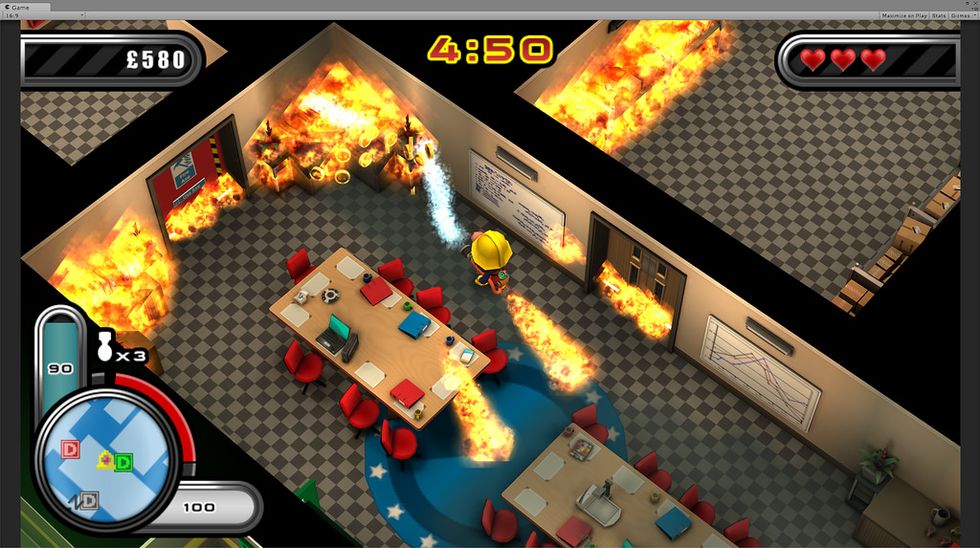
You've two tools at your disposal: a hose and an extinguisher. The former works fine on regular fires blazing across wood and fabric, but it's no good for the electrical variety.


For those, you need to pull out your extinguisher and soak them in foam, preventing them from reigniting of their own accord and making your existence more difficult.
An added layer of complexity presents itself in the form of limited supplies, meaning you must always keep an eye on how full your water and extinguisher levels are.
If they run out, your ability to do your job is quashed, so you'd do well to remember the locations of refilling stations whenever you cross them.
While the concept is simple enough to be attractive, and complex enough to harbour a degree of depth, the execution is sloppy enough to cause you copious frustration.


For starters, the lack of communication regarding how essential interactions and ideas work results in an opening hour that is spent simply dying over and over again.
Struggling to master how a concept works and how you can take advantage of it can be entertaining and rewarding; not being fairly taught how to interact and use it is criminal neglect as far as game design goes.
This early irritation isn't helped by a dual-stick control scheme that fails entirely to make best use of the Vita's inputs. The left stick moves you around the environment and the right aims your tools.
That's fine. The problem comes from the decision to map camera operation to the right stick, too, causing no end of needless annoyance.


Whenever you hit the fire button the right stick operates your hose/extinguisher, while at all other times it's used for camera rotation. Given the isometric viewpoint and the abundance of opaque walls, moving the camera is a need rather than a want.
Not being able to fire and rotate at the same time can and will result in unnecessary deaths as you're burned alive by an invisible fire spreading across a wall behind you.
Given the Vita's abundance of potential touch controls, it's a mystery as to why the camera has been shoehorned onto a stick already serving an essential function.
Compounding the frustration is the repetitive nature of the events that adorn each run through a burning area. There simply isn't enough variety in your available actions and objectives to make multiple level runs worthwhile.
Where the likes of Spelunky measure their rewards, challenges and random-factor near perfectly, Flame Over fails. Each of the 'random' levels feels too similar to the last thanks to the narrow focus of the game mechanics. Most damningly, there's little room for experimentation and creativity when it comes to employing your toolset.
The quality of the artificial intelligence doesn't help, either. Those people (and cats) that are awaiting rescue will regularly get caught up on doors and corners when you ask them to follow you to the exit and subsequent safety.
Extra polish would have gone a long way to improving Flame Over's fortunes, but as it stands it's a few embers short of a fire.
I never thought I'd say it, but I've never before craved the ability to perform a fireman's lift. I wanted it included here.
It's a shame that such ugly problems pop up so frequently, because Flame Over does offer some entertainment in those moments when a level is perfectly balanced and the challenge is expertly pitched.


The simple existence of these moments hints at the underlying promise of the wider concept attempted here, but the random element is so under-developed that those shining lights are few and far between.
Roguelikes are not easy to create and this is the game that proves it. It's all very well having the courage required to allow a mathematical system to randomise a level for your players, but without a clear and engaging set of ideas for them to interact with, the effort is futile.
Extra polish would have gone a long way to improving Flame Over's fortunes, but as it stands it's a few embers short of a fire.








![Chris Hemsworth Bad Times at the El Royale dance [gif]](https://hips.hearstapps.com/digitalspyuk.cdnds.net/18/41/1539256413-chris-hemsworth-bad-times-el-royale-dance.gif?crop=0.4074074074074074xw:1xh;center,top&resize=360:* "Chris Hemsworth Bad Times at the El Royale dance [gif]")