


Rainbow Crew is an ongoing interview series that celebrates the best LGBTQ+ representation on screen. Each instalment showcases talent working on both sides of the camera, including queer creatives and allies to the community.
Next up, we're speaking to Eric star McKinley Belcher III.
The most extraordinary thing about Netflix's Eric isn't the story of Benedict Cumberbatch's drug-addicted puppeteer searching for his son. And it's not the titular seven-foot tall monster who's helping Vincent on his quest either.
No, what's most impressive about Eric is how this already fascinating concept places so much emphasis on Michael Ledroit, the officer assigned to find Edgar amidst the grimy labyrinth of New York City.
What could have just been a generic cop template whose entire life revolves around work is anything but that thanks to smart scripting from The Split creator Abi Morgan, who ensures Ledroit is just as important as, if not more so than, the family at the heart of this story.
Essentially two shows in one — and no, we're not just talking about Good Day Sunshine — Eric jumps between the search for Edgar and Ledroit's search for justice in his personal life, which is marred by the endless torrent of injustice he faces as a closeted Black cop in '80s NYC.
What to Read Next
Digital Spy caught up with Eric star McKinley Belcher III to discuss Ledroit's queer identity and the weight of masking in unsafe spaces.
Coming into Eric, we didn't realise queerness was going to be so integral to the story, but it's great to see that explored in a show where '80s New York features so prominently. This was such a crucial time in our community's history.
It's one of the things that I was really excited about. That not only would I get a really interesting, investigative journey through the show, but that in the '80s, in the middle of the AIDS epidemic, I would get to champion a very queer narrative. One in which we're really diving into the nuances of how one would need to compartmentalise their life at that time, the ways in which sexuality gets leveraged and weaponised in some ways.
As a Black and queer man, there's a lot of weight on Ledroit's shoulders, and there's a lot of compression that's happening in terms of how he's managing all the things that he must do. It's really exciting to show him wrestling with that, with the NYPD and the remnants of institutionalised racism, and watch him navigate how he can be the change.
As much as that is a journey of action, it's also a journey of self-acceptance.
As viewers, we can still feel the pain and anger bubbling just under the surface at the injustice of everything Michael is forced to endure. His boyfriend William is dying back home, but Ledroit has to come into work and pretend everything is fine.
As I tackled Ledroit, I thought a lot about the masks we wear. Some of those masks are worn as a way of coping with the world around you that is not ready to receive you in your fullness.
Ledroit is acutely aware, not only of observing people and how the puzzle pieces fit together in this case, but he's also very much aware of what spaces are safe for him to be all of himself and in what spaces are safe for him to feel. He's gotten very good at masking what he feels in spaces that are unsafe. So it begs the question in what spaces can he actually feel and be all of himself?
It really comes down to that apartment. And then because there's a shared history, albeit a complicated history between him and [Ali] Gator, being in close proximity to him is also a safe space.
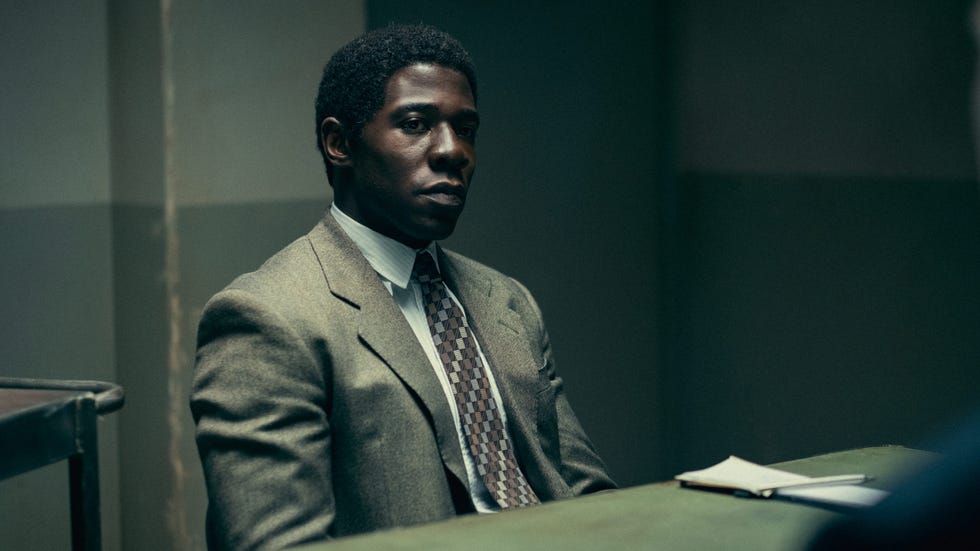
The AIDS epidemic is such an integral part of your character's story, especially through how it impacts his partner, William. It's a chapter of queer history that we often find ourselves returning to, most recently seen in Fellow Travelers and It's a Sin, for example. Why do you think this is such an important topic to keep revisiting on screen?
If we don't fully unpack and acquaint ourselves with what happened in history, and sometimes near-history, we're doomed to repeat it. The fact that we're still dealing with the effects of HIV and AIDS and that there's still a degree of education that needs to happen and that it affects particularly the queer community, but also the world at large. I think it's worth reminding people where we've been with this very human crisis.
I also think that there are many young people who don't — obviously, they weren't alive so they don't remember that — but it's worth sharing what someone's journey through that would have been so we're just not taking it for granted.
Now, in terms of the present, it's a very polarising thing. One of the joys and benefits of telling a story or an issue through a period piece is that it offers us the blessing of distance. The ways in which a topic might be polarising if you set it now... I think some people can just see things a little clearer from a little safer distance.
One scene in particular that really rams this home is at the start of episode five when William's sister confronts Ledroit, blaming him for his partner's death while effectively kicking him out of his own home. It's a very pivotal moment for Michael and also the show at large.
I love that you noticed that. Previously, at the end of episode four, we see Ledroit just after William has died at the hospital. He is not given a moment to grieve or fully experience the weight of what has just happened to both William and to him in his life because he's in an unsafe space in a hospital where he can't even claim William fully as his partner. And then, when he witnesses it, William's sister comes in before it's fully landed on him and he must comfort her.
So the irony of... I don't know if it's the next day, but like, a couple of days later, that's the conversation that we're gonna have? Not only is she gonna blame me for William's death, but then strip me of home, comfort, and the validity of our relationship?
There was a lot of conversation about that specific scene with the sister in the kitchen, and some movement about how Ledroit would react and the language he would use. Director Lucy [Forbes] and Abi [Morgan] really trusted me a lot with that scene because we changed some things so that Ledroit would more acutely address what it is that he was feeling and what it is that he was witnessing that she was doing.
Was there anything else you were able to bring to the role that wasn't necessarily in the script? Perhaps something else you improvised or some personal aspect of yourself?
To me, this is the great joy of this work. That, as a Black queer man, I get to bring my whole experience to the show. It's something that I was looking for, to be challenged in the way that the show is interested in the character, on playing his whole heart, so I can bring my whole heart. I'm not trying to Trojan Horse stuff in. It's an open conversation about what is relevant to what this person's experience was.
Some of it is not in the show. Some of it is helpful for getting me to the places that are in the show. But some of the stuff with Gator in the last episode, both in the bedroom and in the living room. Most of that is completely scripted, to be credited to Abi, but there are bits in there that are improvised, some pieces that Abi and I sort of massaged, just to make sure that we were putting a finer point on the weight on Ledroit's shoulders.
We've watched him over the six episodes tamp down so much. I thought it was really important that we acknowledge that weight, what it feels like to be that compressed. It's only in a line or two. That stuff really excites me, to give little hints and suggestions of what a person is feeling and experiencing.

By the end, Ledroit does have a chance to decompress somewhat by speaking his truth and make change, important change. It all ties back to the show's central theme which is about finding home, whether it be a missing child returning to his parents or something more metaphorical. With that in mind, what does coming home mean to Ledroit?
Over the course of the show, Ledroit's journey is finding a sense of home in himself, which is being comfortable with himself, being able to stay firmly in his truth, and in loving himself so that he can be the change that he wants to see in the world.
So in that sense, I think metaphorically, home is here. Like fully inhabiting this body and spirit and all that you are in queerness and not.
Then literally, William and Gator are very special for him. They aren't buildings or an apartment or anything, but they both offer a very specific sense of home for Ledroit.
They're both a sanctuary for Ledroit, that safe space we were discussing earlier, but embodied in a person rather than in a physical space.
Absolutely. And in a broader sense, New York is home. As an officer who is commissioned to safeguard his community, Ledroit is taking a real responsibility in safeguarding his home.
What message do you hope people take away from watching Eric?
There are a couple of journeys that you can follow over the course of the show. There's this whole puppet show that makes me think about Sesame Street and the fables we tell to children that somehow have resonance for adults. At the centre of all of those little strands is this very simple notion that it is incredibly important to lead with love.
Regarding Ledroit's journey, you can't offer love or the best of yourself to the world until you learn to love yourself.
Looking back, is there a particular example of queer storytelling in TV or film that really resonates and speaks to you on a personal level?
I grew up in a very conservative Christian household so I was not seeing anything remotely queer when I was a kid. I think the very first time, I'm just thinking of this now, the very first time that I saw a queer person represented in anything was Philadelphia with Denzel Washington and Tom Hanks.
I have not seen this movie in years, but there is a moment where there's opera singing and it's sort of a subjective thing where it's half reality and half in his head that's seared into my memory now.
In terms of the first two films that are imprinted in my mind and in my heart as a queer man, one is Rent. The music is great and it's an iconic musical, but there's a kind of tenderness that happens between those two characters that made me rewatch the thing over and over again.
And the other is very recent; Moonlight. Some of that is just how beautifully it's photographed and how unafraid of Blackness it is. To really see someone navigate the chapters of their life and how a person changes and doesn't change is kind of just beautiful.
Eric is now available to stream on Netflix.
You Might Like...


After teaching in England and South Korea, David turned to writing in Germany, where he covered everything from superhero movies to the Berlin Film Festival.
In 2019, David moved to London to join Digital Spy, where he could indulge his love of comics, horror and LGBTQ+ storytelling as Deputy TV Editor, and later, as Acting TV Editor.
David has spoken on numerous LGBTQ+ panels to discuss queer representation and in 2020, he created the Rainbow Crew interview series, which celebrates LGBTQ+ talent on both sides of the camera via video content and longform reads.
Beyond that, David has interviewed all your faves, including Henry Cavill, Pedro Pascal, Olivia Colman, Patrick Stewart, Ncuti Gatwa, Jamie Dornan, Regina King, and more — not to mention countless Drag Race legends.
As a freelance entertainment journalist, David has bylines across a range of publications including Empire Online, Radio Times, INTO, Highsnobiety, Den of Geek, The Digital Fix and Sight & Sound.


