One wrong turn on the way to Sesame Street is exactly where you'll find Abi Morgan's Eric: deep in the belly of the wrong side of town, where the resident furry blue monster has a meaner bite than a feral Cookie Monster ever could. But that's what makes it deliciously intriguing.
The muted tones, all vibrancy drained out of the visuals, allude in part to the humdrum of 1980s New York. Humdrum, that is, until a young boy, Edgar (Ivan Howe), goes missing.
Edgar's disappearance shakes people into action, kicking up the dust to reveal child exploitation, grooming and drug abuse. The noise stirred up by his absence takes the desperate plea of a missing Black child's mother out of the vacuum she's been screaming into and shoves it into the shadow of Edgar's own seemingly hopeless case, piggybacking off their will to find him.
That's where we meet Michael Ledroit (McKinley Belcher III). A Black, closeted queer policeman facing an impossible decision while his own personal life is in utter turmoil.

While the health of his AIDS-suffering partner William (Mark Gillis) begins to fail, he has been tasked with solving Edgar's disappearance and by proxy that of Black teenager Marlon Rochelle.
There is a complacency behind his superiors' insistence that they plough on with Edgar's 'lost cause' case, like a necessary tick-box exercise. However, his dismissal of Marlon's disappearance is active, fuelled by an intentional unwillingness.
What to Read Next
We later discover that this is partially down to a police cover-up. But the wider world's (and the precinct's) acceptance of Marlon's falling through the cracks at the same time an appeal for news on Edgar reaches television status, speaks to the disparity between the value placed on Black and white lives.
The contrasting attitudes towards two similar cases force Belcher's Michael into a position where his commitments to his job and his community are heavily tested.
Browbeaten by systemic racism, does he follow orders simply to get by or does he rise up and serve his community by finding Marlon?
Belcher's ability to convey the weight of Michael's predicament sings as his character flows effortlessly from simmering rage and professional defiance to dispirited complacency. The ebb and flow between them becomes more acute when faced with Marlon's mother Cecile (Adepero Oduye).
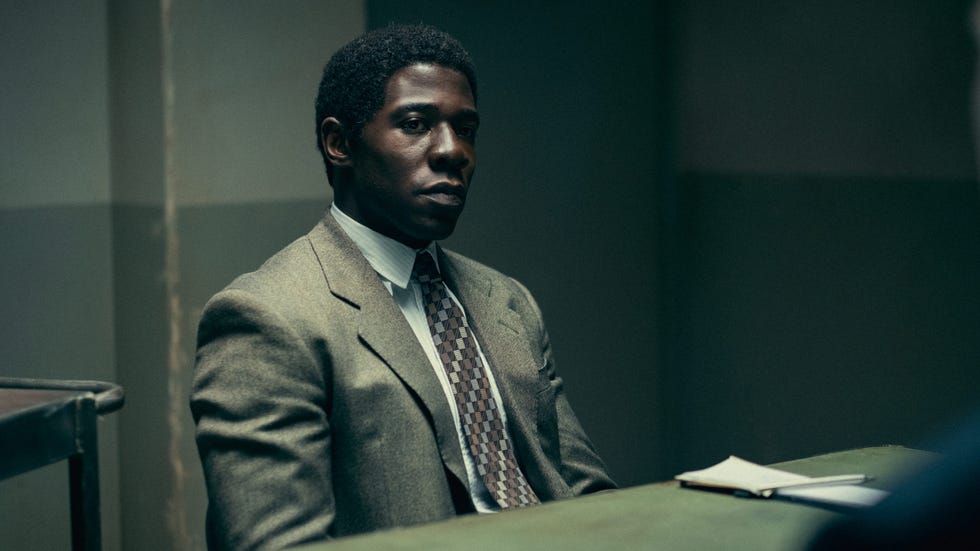
At first, Michael's reluctance to rock the boat at work is evident by his avoidance of Cecile. Her persistent calls and frequent visits to the police station serve as a manifestation of his guilty conscience, imploring him to do better.
"As a Black and queer man, there's a lot of weight on Ledroit's shoulders," Belcher told Digital Spy.
"There's a lot of compression that's happening in terms of how he's managing all the things that he must do.
"It's really exciting to show him wrestling with that, with the NYPD and the remnants of institutionalised racism, and watch him navigate how he can be the change."
It isn't long before Cecile's prompting has him relenting to that 'change,' and one of the most poignant scenes which spurs Michael on is during a talk with her that brings the dichotomy within Michael to the foreground.
He remains half-convinced himself when he promises Cecile that no one has forgotten Marlon, in particular him. Even less so when she tells him, "Then you're just not pushing hard enough."
Her words strike a chord as she goes on to fight for the right to bring her son home.
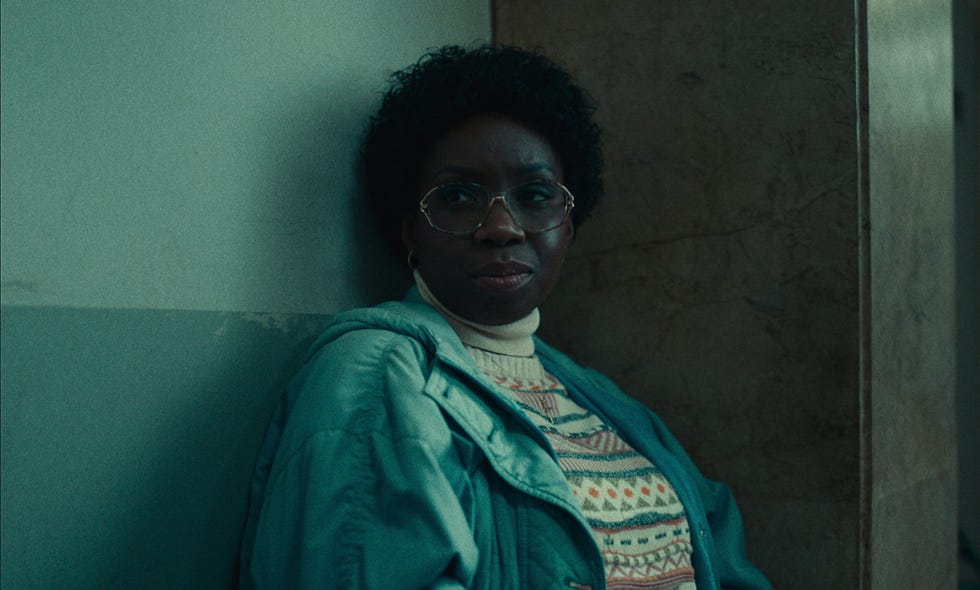
"I wanna hold my son," she tells him. "I wanna hold him in my arms. Even if all you can find is his skull."
Though she is desperate she is not pleading. Instead, she is resilient and determined, finding dignity in fighting for Marlon to be awarded the same rights as Edgar.
She finishes with: "I will keep coming and coming and coming until you can do something more than giving me sorry and driving me home. You are better than that."
In this painfully beautiful and frank conversation between the two, Belcher is able to capture what it means to constantly have to navigate one's Blackness in a professional environment.
The difficulty of fighting the urge to shrink into oneself and suppress your identity conflicts with allowing your lived experience to guide you authentically, even when uncertain how it will be received.
There is a beauty in the way Belcher balances this task, both on the Black and queer front as Eric asks both too much and just enough of him.
His conversation with Cecile pushes him down a path where he is no longer able to look away from the truth of the deplorable things happening in the seedy areas of this already dark show.
Through the ugliness he is able to find a way to live his truth, consequences be damned.
Eric is now available to stream on Netflix.
You Might Like...




TV writer, Digital Spy Janet completed her Masters degree in Magazine Journalism in 2013 and has continued to grow professionally within the industry ever since. For six years she honed her analytical reviewing skills at the Good Housekeeping institute eventually becoming Acting Head of Food testing. She also freelanced in the field of film and TV journalism from 2013-2020, when she interviewed A-List stars such as Samuel L Jackson, Colin Firth and Scarlett Johansson. In 2021 she joined Digital Spy as TV writer where she gets to delve into more of what she loves, watching copious amounts of telly all in the name of work. Since taking on the role she has conducted red carpet interviews with the cast of Bridgerton, covered the BAFTAs and been interviewed by BBC Radio and London Live. In her spare time she also moonlights as a published author, the book Gothic Angel.


