
Jupiter's Legacy spoilers won't be found here.
Between Marvel, DC, and more mature offerings like The Umbrella Academy, it sometimes feels like every superhero story has already been told. There's just so much comic book content around these days, but that hasn't stopped Netflix from stepping into the ring with a new shared universe of its own.
And why should it? After all, Millarworld is the brainchild of legendary writer Mark Millar, the man behind fan-faves like Civil War. If anyone can compete with The Big Two, it's the creator of Jupiter's Legacy. But is this new show of his a perfect paragon of superhero storytelling? Or does it suggest that things aren't quite as utopian as we'd like in the world of Millar?

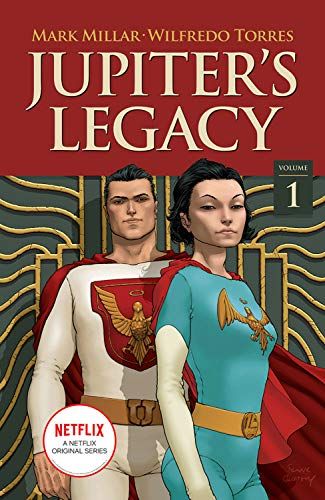
The cast recently described Jupiter's Legacy as "an evolution of the genre," and that was perhaps true when the comic first came out in 2013. Millar's exploration of American ideology wasn't the first vigilante story to tackle mature themes, but few have successfully addressed such difficult topics within the classic superhero framework.
The bare bones of Jupiter's Legacy remain intact on screen. Both Millar's original story and Netflix's adaptation revolve around the generational conflict between ageing heroes and their younger, upstart children. The focus of both stories is Sheldon Sampson, a Superman stand-in who founded the world's first superhero team and also a superhero family of his own.
The Utopian, as he's known in public, struggles to maintain order in a world that has since moved on from his "old-fashioned" notions of right and wrong. Through this prism, Jupiter's Legacy explores that grey area between what's just and what's right, tackling lofty themes that Golden Age comic books once avoided.
What to Read Next
That all sounds great on paper, and it is great on paper, but Jupiter's Legacy doesn't work as well on screen, and its approach isn't as novel as it once was either. Everything included here has been done before on other shows, and for the most part, it's been done better.
Looking for dysfunctional family dynamics? Umbrella Academy is more fun. Fancy some impressive-looking flashbacks that explore generational trauma? Watchmen is a lot smarter. And even if you're just looking for some gory violence, The Boys should definitely be your first port of call.
And that's unfortunate, because there are some aspects of Jupiter's Legacy that do work really well. Elena Kampouris is a clear standout in the role of Sheldon's daughter, Chloe, who is left adrift and overwhelmed by all the pressure that comes with being part of the Sampson family.

And it doesn't help that she ends up dating Hutch Hutchence (Ian Quinlan), the son of the world's greatest supervillain. Their relationship adds a neat wrinkle to this enduring notion of legacy and how it's often intertwined with pain. Hutch also stars in some of the show's very best scenes, including one unforgettable moment that involves shark-infested waters.
Unfortunately, most of these killer moments occur in the present-day timeline, and that's only half of the story. To offset these modern scenes and bring more prestige to the show, Jupiter's Legacy spends a long time exploring The Utopian's origin in 1929 Chicago. It's a bold idea, one that helps set this show apart to some degree, but the problem is that these flashbacks just aren't very interesting.
In a world where viewers are now familiar with countless superheroes, origin stories can be a hard sell at the best of times, and this one in particular takes eight episodes to unfold. Not all of us age as slowly as The Utopian, so why choose to drag things out so much?

The present-day timeline follows a wider range of characters with conflicting goals, so this instantly makes the show more interesting, but there are still some pacing issues here too. Following one big fight in the first episode, quite a few core characters end up with very little to do until the finale. And that includes The Paragon (Andrew Horton), Sheldon's son, despite initially being set up as the lead.
Combine all that with some less-than-stellar special effects, and you're left with a show that feels as tired as these old heroes look. And that's a shame, because there is half an interesting story here, even if it's no longer that original in 2021. For diehard fans, Jupiter's Legacy is still worth a watch. But now that there's so much superhero content to choose from, it's disappointing that Millarworld's first show doesn't "evolve" the genre as much as we hoped and expected.


Jupiter's Legacy is now available to watch on Netflix.


Digital Spy's digital magazine is back – and we've got an EXCLUSIVE interview with Dave Bautista. Read every issue now with a 1-month free trial, only on Apple News+.
Interested in Digital Spy's weekly newsletter? Sign up to get it sent straight to your inbox – and don't forget to join our Watch This Facebook Group for daily TV recommendations and discussions with other readers.
After teaching in England and South Korea, David turned to writing in Germany, where he covered everything from superhero movies to the Berlin Film Festival.
In 2019, David moved to London to join Digital Spy, where he could indulge his love of comics, horror and LGBTQ+ storytelling as Deputy TV Editor, and later, as Acting TV Editor.
David has spoken on numerous LGBTQ+ panels to discuss queer representation and in 2020, he created the Rainbow Crew interview series, which celebrates LGBTQ+ talent on both sides of the camera via video content and longform reads.
Beyond that, David has interviewed all your faves, including Henry Cavill, Pedro Pascal, Olivia Colman, Patrick Stewart, Ncuti Gatwa, Jamie Dornan, Regina King, and more — not to mention countless Drag Race legends.
As a freelance entertainment journalist, David has bylines across a range of publications including Empire Online, Radio Times, INTO, Highsnobiety, Den of Geek, The Digital Fix and Sight & Sound.


