
Any fears we had that Hwang Dong-hyuk might just take the money and run with season two of Squid Game were roundly kicked out of the playground by the end of the first episode.
You can read Digital Spy's full review here. We've got a tighter focus right now though: like Gi-hun, Hwang has taken his enormous winnings and ploughed them back into attacking the corporate machine that fed him.
Squid Game season two episode one spoilers follow.
We don't just mean Netflix, by the way – if the streaming-industrial complex was able to broadcast season one without blushing, season two won't make them any more embarrassed, though it probably should. When we say corporate machine, we're talking about capitalism, full stop.

Gi-hun's quest takes place over the course of the season (and will continue in season three). In the first episode, he laboriously tracks down the Recruiter, who's busy tormenting the homeless with a starkly satirical choice of bread roll or lottery ticket.
For Hwang meanwhile, his theme is laid bare in microcosm in a single, brutal scene – that final confrontation between Gi-hun (Lee Jung-jae) and the well-groomed ddakji player (Gong Yoo), who represents entry to the games.
What to Read Next
As we remember from season one, the Recruiter appears both handsome and wealthy: he's a poster-boy for capitalism, well-tailored and personable. Play the game, the implied promise goes, and you too could end up like him.
His final game of Russian roulette with Gi-hun, however, allows showrunner Hwang to lay bare the philosophy that the Recruiter embodies.
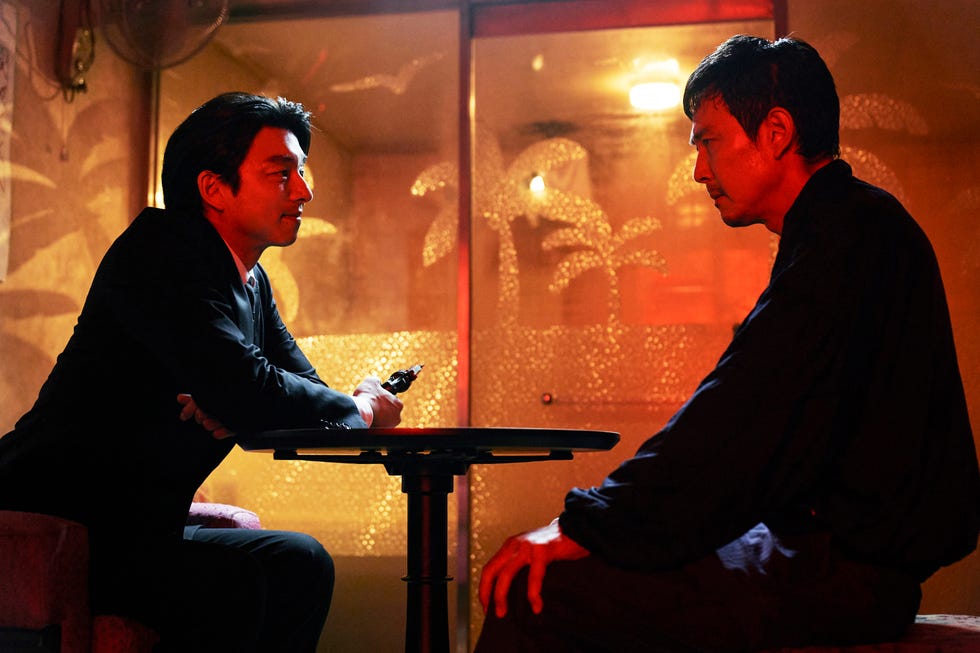
With one bullet left and a 50/50 chance of death, Gi-hun has stared death in the face twice already and now has the gun.
As the operatic strains of Andrea Bocelli and Sarah Brightman hover in the background, the Recruiter taunts him with the option that Gi-hun could murder him (and thereby take the key to his boss's identity), "but I'll have you admit one thing. That you're a piece of trash, just like everybody else. A piece of trash who got lucky and made it out of the dumpster."
It is vital to the Recruiter's sense of self that Gi-hun agrees that this is true. Because if he doesn't, if Gi-hun can prove that his success was actually down to his integrity – his kindness, courage, belief in cooperation and collective strength, in short his rejection of the terms dictated by the games – then the Recruiter's life has been built on a lie.
He is able to kill people, even apparently his own father, because he believes that nothing matters, so why not take what you can get? He believes he is the master of his own fate.
But Gi-hun has a higher knowledge born of his experiences in the game and can see through this adolescent pose.

Rather than kill the Recruiter, Gi-hun puts his money where is mouth is – and his gun where his forehead is – and pulls the trigger, demonstrating that he would rather die than betray the truth that he lives by.
His risk pays off: he lives. The Recruiter seems surprised that he went through with it. And now the tables are turned.
"With a single pull of the trigger," Gi-hun says, "you could kill me. But… I'll have you admit one thing: you put a mask over your face and do whatever your master says. You run, bark and wag your tail for them. You're nothing more than their dog."
This brilliant reversal leaves the Recruiter in an unwinnable position. There are no empty chambers left. He must kill himself if he believes in the rules. But if he cheats and kills Gi-hun, then Gi-hun is right, and he is nothing. He doesn't represent (capitalist) power, he's just a tool that power uses.
And that's why he shoots himself: not because he thinks the game is more important than the player, but because Gi-hun was right, and his own life's philosophy has been exposed as a sham.
This season asks us all what we would do if push came to shove. Well, we know what Gi-hun would do. Push has come to shove, and he is pushing back.
Squid Game is available to stream on Netflix.



Editor, Digital Spy Chris has over 25 years' experience as a writer and editor, having worked as a journalist covering TV and movies since the '90s. Starting out as a TV listings editor at the Press Association, he was quickly hired by the nascent Heat magazine, where he rose to become Senior Editor, interviewing the likes of Simon Cowell, Boris Johnson and Paris Hilton. Over the years he has written about entertainment with clarity and wit for Heat, Elle, Q, The Telegraph and of course Digital Spy, and has served many times as a judge in the Royal Television Society awards. He has written and recorded a novelty single with Lord Lloyd-Webber, written scripts for the National TV Awards, made Noel Edmonds cry, accidentally punched an Inbetweener and stolen a small piece of rubble from the Battle of Hogwarts movie set. (They can't have it back.) LinkedIn


