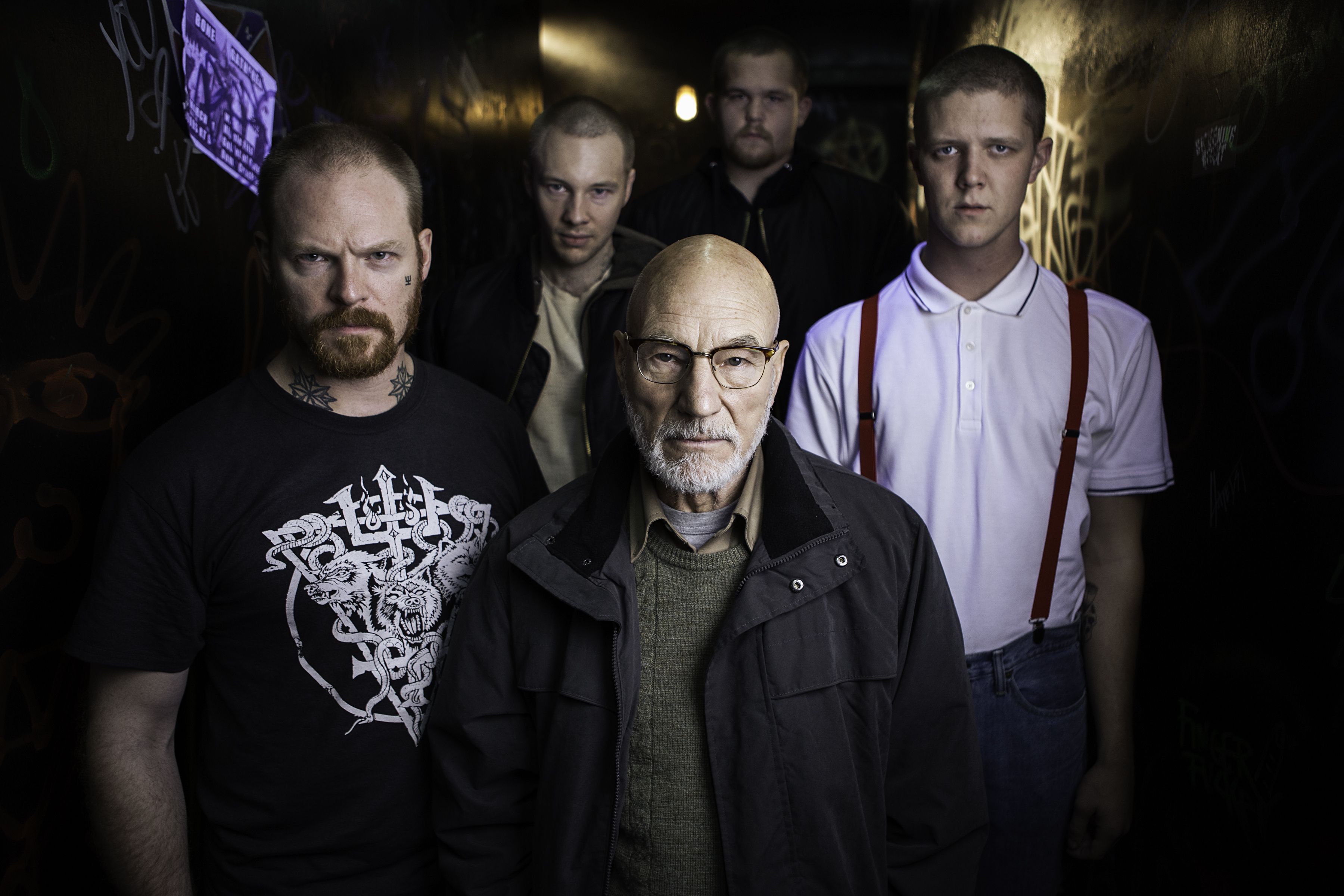
Patrick Stewart is a cool guy - from his longstanding friendship with Ian McKellen, his owning of the internet, dressing up in a lobster costume and of course playing 2 of our favourite heroes: Professor Xavier in the X-Men movies and Captain Jean-Luc Picard in Star Trek: The Next Generation (as well as all the other things he's done in his illustrious career on stage and screen, of course).

Next up he's playing violent neo-nazi Darcy Banker in edgy thriller Green Room, the follow-up to Blue Ruin from director Jeremy Saulnier.
In an exclusive interview with Digital Spy, Patrick Stewart reveals he's just as lovely on set to his animal co-stars as his human ones…


Congratulations on Green Room – we loved it!
"I'm so glad to hear that, I like it too! It's a very unusual and extremely skilled piece of film making."
You're not the obvious choice to play a backwoods American Neo-Nazi. How did you prepare for the role?
What to Read Next
"Well – I'd be interested to know why you say that?"
Well, you're an Englishman for a start, and as a man who projects honour often on screen...
"Well occasionally. But that's not my job, that's not what I do. You're not the first one to bring this up right away at the beginning of the conversation - 'This is a turn around for you' – no, it's not. I have played all kind of roles all of my 66 years as a professional actor, including characters who are far worse than Darcy Banker.
"So I happened to play two roles that I'm most well known for – and by the way, Star Trek ended 25 years ago and my last X-Men movie was 5 years ago – so it disappoints me when the press responds with 'My, what were you thinking taking on a role like this, that's a bit unexpected,' but no, it's not unexpected!
"The last major stage role I did was Macbeth, which is one of the nastiest, bloodiest, most terrifying productions anyone has ever seen, so it's mildly irritating when people say 'this is a surprise' because it isn't a surprise to me, it's what I've done all my life! I wanted to get that out of the way so we don't spend the next ten minutes talking about Star Trek and X-Men."


Never crossed our mind. You've said you were alarmed when reading the script - what struck you particularly about it?
"I've told this story quite a few times about how I first came to the script: I hadn't even got to any of the bad stuff in the script when I put it to the side and went around my house checking all the doors and windows and turning on the perimeter lights. It was a growing sense of unease. Of 'something is wrong here', and I got the feeling that it was not going to end well, which is something that Darcy Banker says. 'This won't end well, gentlemen'.
"I found that very compelling. It's the sort of writing that I've always been drawn to, the kind of writing and film-making that you saw in Psycho and Deliverance. It just made me very uneasy and it was that uneasiness that made me want to make sure I was safe and secure in my house in west Oxfordshire.
"But then I went back to the script and finished it and found that my instinct had been exactly right, because bad things were going to happen and they were going to get worse and worse until a climax that was simply terrifying involving pitbulls and hacksaws and machetes and box cutters and all sorts of things, and I knew as soon as I closed it, it scared the wits out of me, and, watching Green Room, it still does.
One of the things we love about the screenplay is everyone has an arc, even the attack dogs.
"That's absolutely true, bless them, those lovely dogs. Because pitbulls are the loveliest, sweetest dogs in the entire world, there are none nicer, it's just the way they're brought up that makes a difference. Everybody has a story. Even the members of the other band.
"Jeremy is a very thorough filmmaker. Within a couple of days of starting work - because when I arrived they were already shooting the movie - I got the sensation watching Saulnier work in the early days that he already had a cut version of the film running in his head, so clearly that he knew exactly what he wanted to do."

Some of the scenes of violence are genuinely sickening to watch – how does it feel to watch them happening on set?
"I avoided those moments. Somebody came to my trailer at one point and said, 'They're doing the scene with the dog ripping out the girl's throat'. I said, 'You know what? I'll just stay in here reading my newspaper.' I love pitbulls so much I didn't want to see one of them being characterised in that way.
"By the way, after it had done that, when they were putting this dog Brownie back into his cage to be taken home, I went over and said to the dog handler, 'Is it okay if I have a word with the dog and say well done?' and he said, 'Oh, absolutely!'
"So I went over and the dog came along, and he was standing on the flap at the back of this vehicle, and he came over to me and looked me in the face, and then he put out his tongue and he licked me from my chin up to my eyebrows. It was the sweetest gesture and I put my arms around him and gave him a great big hug. You wouldn't believe it was the same dog you see in the movie.
Do you have any sense of Darcy's backstory?
"I have a very detailed backstory, it was one of the first things I asked of Jeremy. After I had read his screenplay I got him on the phone and we talked about this and I said, 'Look, I feel I would really like to have a sense of where Darcy came from that leads him to this situation: what were his hopes and ambitions?'
"And then within 24 hours, back came a three-page document about Darcy Banker which was absolutely terrific and was very very valuable to me because as we quickly know he's not an electrical repairman – though that's what's written on the side of his van – and his main activity is not running a music venue in the Oregon woods either, it's something else, it's what's under the floor of that music venue as we see in the film.
"In the film his main objective is not so much his white supremacists and what will happen to them and the party, it's the business that he has concealed under the floorboards."


He's pulling the strings even more than we realise.
"Oh yes. He has a great deal to lose and that was for me a terrific motivation for his actions and behaviour in the film, which are very extreme."
There's a great stillness to him…
"He's surrounded by so much action and violence and loudness. The music alone some people might look on as being a punishment. The violence when it happens is so powerful and physical that very early on it seemed to me that Darcy's manner and attitude and his style of running this project should be very calm, very considered, apparently very helpful, his attempt is to make these kids think everything is going to be fine.
"All they have to do is get rid of that gun and then they can go on their way. And of course he's lying. Stillness and softness and quietness seemed to me the most obvious choice given what it was surrounded by in the movie.
Would there be space for a spinoff for Darcy as a younger man? Maybe get James McAvoy to play a younger Darcy...
"Very funny. I don't think James would want to shave his head twice!"
Green Room is in cinemas now.


