
The ending of Ashes blurs the boundaries between fiction and reality as the romance at the centre of the plot comes to a tragic end.
Son Yaz stars Funda Eryigit and Alperen Duymaz reunite on screen for this movie, originally titled Kül and now available on Netflix. Thanks to its heated romance and steamy scenes, we are already counting it among the best sex movies on Netflix.
The story follows Gökçe (Eryigit), a wealthy woman from Istanbul who comes across a mysterious manuscript, which stands out among the many drafts her husband Kenan (Mehmet Günsür) receives as a book publisher. Gökçe owns her own boutique and takes care of their son Ege, but she also finds time to help Kenan decide which authors are worth publishing.
What to Read Next
This manuscript, however, will turn her world upside down.
After ten years of dull marriage and a life of empty luxury, Gökçe finds herself brimming with excitement while reading this anonymous book called Ashes, where a woman describes her passionate affair with a man named 'M'.
When she realises the book is not entirely fictional, featuring real-life locations in the neighbourhood of Balat and very accurate descriptions of its main character, Gökçe feels compelled to find out more and live this romance in her own skin.
Major spoilers ahead.

Ashes ending explained
Gökçe lives her fantasy. She finds Metin Ali, aka 'M' (Duymaz), who as the book states is a carpenter in Balat, has tattoos and owns a romantic rooftop with amazing views of the city.
Their relationship goes from shy flirting to aggressive lovemaking, but the secrets between them are too big to ignore.
When Gökçe actually finishes the book, she finds out that the female character in the story is dead, and she points at M as her killer. Why wouldn't this be the truth if the rest of the story was extremely accurate to real life? But how could this woman write about it if she really died?
Not knowing how to separate reality from fiction anymore, Gökçe faces a full mental breakdown. "I mix everything up," she tells M as she loses grasp on reality.
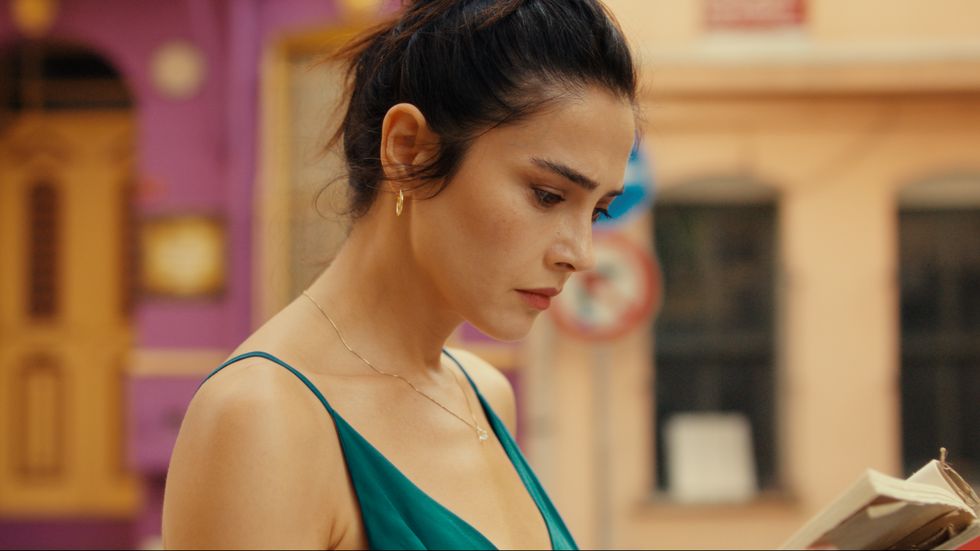
Earlier that day, Gökçe returned the manuscript to her husband, saying it's not up for publishing. She said it's poorly written, "overdramatic" and the ending is "just dull". Kenan knows this book is related to his wife's change of behaviour, so he reads and quickly catches up with what's been going on.
Kenan goes one step further and finds the home address from where the book was sent a year ago. A woman named Reyhan Akkaya opens the door and claims to know nothing about the book. She reveals, though, that her sister Duygu was living with her at that time.
Like in the book, Duygu is dead, although the circumstances of her death are unknown.
Kenan forces a face-off between him, Gökçe and Metin in their house after asking the carpenter to deliver a bookcase.
Seated at the dinner table, everything comes to light.

Kenan accuses Gökçe of suffering from fictophilia, or the state of falling in love with a fictional character. He calls it a serious disorder.
He also reveals that Metin made Duygo fall in love with him and then slept with her sister, breaking her heart and making him responsible for her death. Gökçe asks Metin directly if he killed her.
M is furious at these accusations. He reveals Duygu was obsessed with him, and she attempted suicide many times when she skipped her medication.
That's all the information they share before the two men start fighting and breaking every single piece of glass in the room.
Gökçe is visibly devastated. She remains seated at the table with an odd expression in her face, like she is fully detached from reality and she is not sure that what is happening in front of her is even real.
Real or not, Kenan and Metin fall into the swimming pool, still fighting, until Metin stabs the other man with a piece of glass. We assume he is dead.

Suddenly the scene ends and we hear the same words that introduced the movie: "What is reality and what is fiction?"
Now we know the person saying those words is Taner Alpar, an author we met at Gökçe and Kenan's 10th wedding anniversary party at the start of the movie. At that party, Kenan advises him to stop writing about his own life and find something fresh to write about.
It seems he did find something new. His new work is called Ashes (Kül), just like Duygu's manuscript. He is in the middle of the book presentation.
"Reality could be a lie that someone made up, don't you think? Maybe we're all living in someone else's dream," he says.
Someone in the audience asks why he made his main character die by suicide. He reveals a connection with Leo Tolstoy's 1878 novel Anna Karenina, where the protagonist suffers the same fate.
Another member of the audience asks him about his writing process and his sources. "I realised I was writing too much about myself," he answers, echoing Kenan's words at the beginning of the movie. In the first row, Alpar's wife (and Gökçe's friend) smiles mischievously.
"Imagine infiltrating someone else's mind. Seeing life through their eyes. That's how Ashes was born," he adds.

In the final scene of the movie, we see Gökçe in the train station. Is she going to jump, like Anna Karenina? The question hangs in the air as the image fades to black and Ashes ends.
What does this ending mean? We can only theorise.
The most plausible conclusion is that everything we saw is real (Duygu sent the book before her suicide, starting a series of events that led to Gökçe and Metin's affair and Kenan's death) and Taner Alpar saw the opportunity to use that story to write a new book afterwards.
Alpar shows an interest in real stories, since he has spent a career using his own and he said at the anniversary party that he looks at newspaper stories for inspiration. His wife's smile and the veiled reference to Kenan's hurtful comments about his writing during the book's presentation could mean this is his revenge against them.
It's precisely that thirst for revenge that could lead viewers towards other theories.
What if Alpar found out about Duygu's story and wrote the original manuscript of Ashes as an experiment? Through his wife's insights into Gökçe's life, he might have been aware of the couple's issues. He couldn't know everything would develop the way it did, but maybe it was a pleasant surprise and much-needed inspiration for his work.
And then there's the last scene. Does Gökçe jump or not? With her son holding her hand, we doubt it. If the events of the movie are to be believed as reality, her husband is dead and now she has to start a new life. It's unlikely she does so with Metin.
But what if it was all fiction? Then maybe what we are seeing is the end of Alpar's book and, like Anna Karenina, Gökçe is about to jump to meet her end.
Ashes is now out on Netflix.
You Might Like...



Mireia (she/her) has been working as a movie and TV journalist for over eight years. Based in the UK, she is a former deputy movies editor at Digital Spy, and previously worked for the Spanish magazine Fotogramas. Mireia's work has been published in other outlets such as Esquire and Elle in Spain, and WeLoveCinema and GamesRadar+ in the UK. She is also a published author, having written the essay Biblioteca Studio Ghibli: Nicky, la aprendiz de bruja about Hayao Miyazaki's Kiki's Delivery Service.
During her years as a freelance journalist and film critic, Mireia has covered festivals around the world and has interviewed high-profile talents such as Kristen Stewart, Ryan Gosling, Jake Gyllenhaal and many more. She's also taken part in juries such as the FIPRESCI jury at Venice Film Festival and the short film jury at Kingston International Film Festival in London. LinkedIn


