The Zone of Interest has become the first British movie to win Best International Feature Film at the Oscars, shining a brighter light on one of this year's most important movies.
In his winning speech, writer/director Jonathan Glazer said: "All our choices were made to reflect and confront us in the present, not to say look what they did then, but rather look what we do now.
"Our film shows where dehumanisation leads at its worst. It's shaped all of our past and present. Right now, we stand here as men who refute their Jewishness and the Holocaust being hijacked by an occupation which has led to conflict for so many innocent people.
"Whether the victims of October the 7th in Israel or the ongoing attack on Gaza, all the victims of this dehumanisation, how do we resist?"
It could well be that, before this speech, you would have thought that The Zone of Interest is a historical movie about the Holocaust, but it's always been so much more than that.

The story follows German Nazi commandant Rudolf Höss (played by Christian Friedel), who strives to build a dream life with his wife, Hedwig (Sandra Hüller), in a new home next to the Auschwitz concentration camp.
What to Read Next
However, The Zone of Interest isn't just a Holocaust story, to be viewed and understood within the time capsule of 'historical drama'.
The phrase 'timely allegory' is often bandied about, but in the case of The Zone of Interest, this couldn't be more true, because we are all, to a greater or lesser extent, the family at the heart of this nauseating drama.
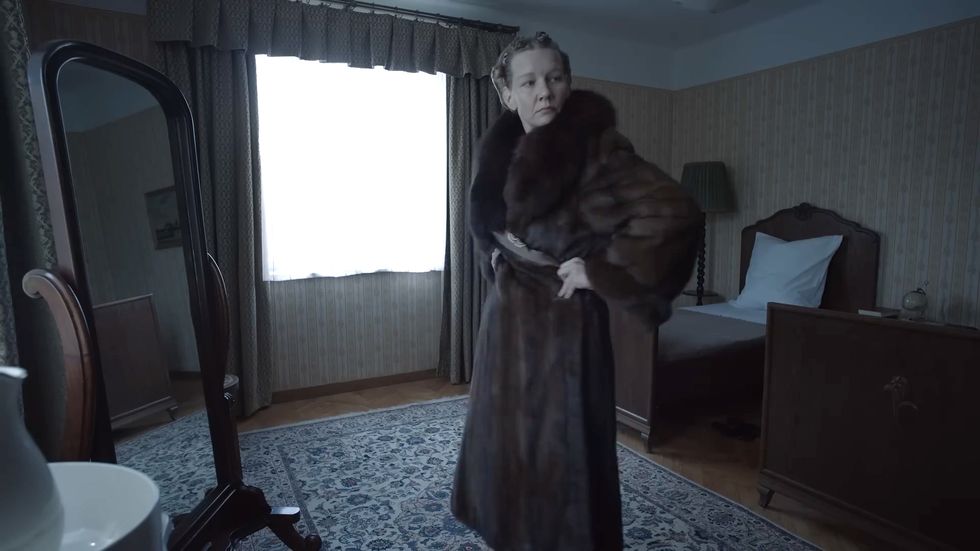
We watch as Hedwig reaps the benefit of the slaughter of Jews, Romani, LGBTQ+ people, political dissidents, the disabled, and others whom the Nazis deemed undesirable. She wears their clothes, uses their lipsticks, and watches from her luscious paradise of a garden as the camp's fires blaze in the background.
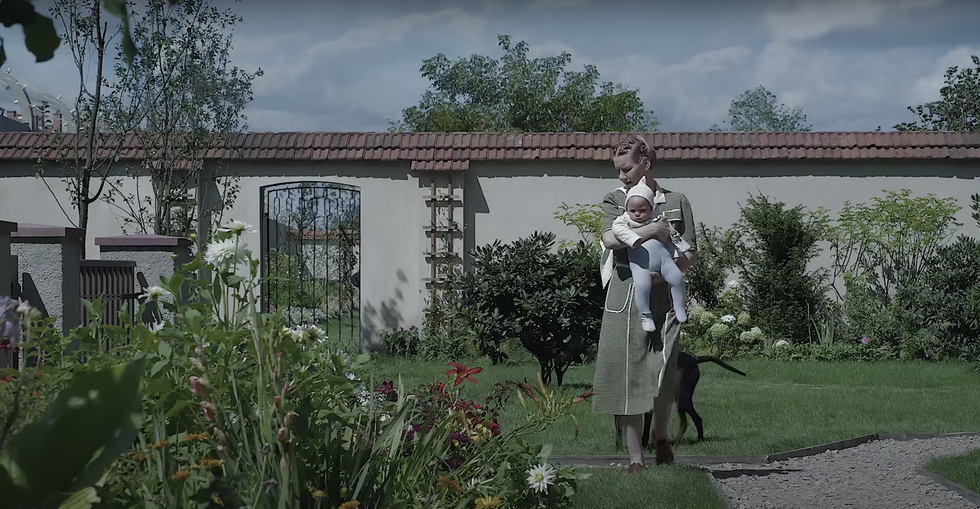
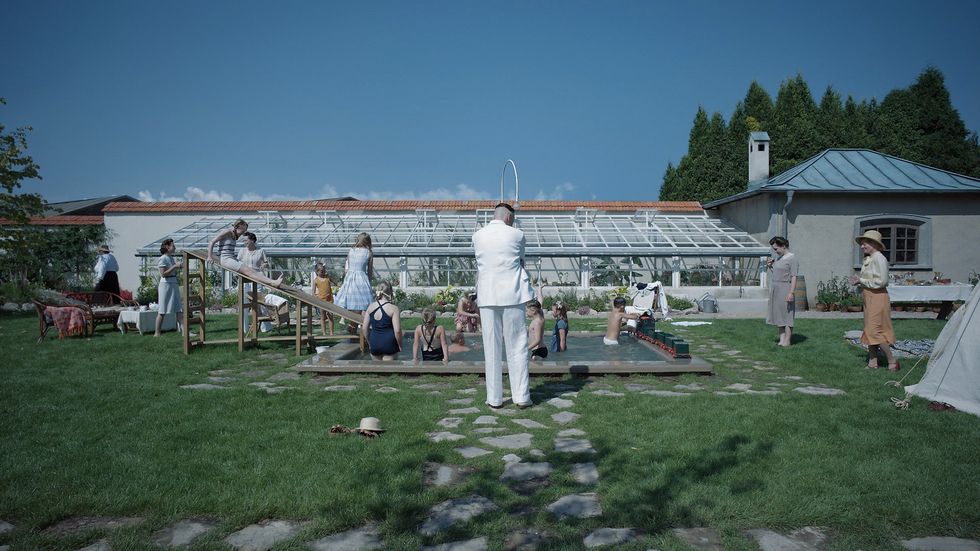
This lens of realism through which Glazer frames the murders at the concentration camps highlights their atrocity. By placing Hedwig and her drive to hold onto the life she's built beside the camp at the centre of the story he puts us, the audience, in her shoes.
And we are. We sit at computer screens and see the flurry of photos and headlines about the murders of Palestinians, Uyghur Muslims, Ukrainians and more. We may not wear the jackets that were taken from their bodies, but we live in such a globalised society that we cannot buy a soda or a piece of clothing without indirectly (or directly) supporting systems that inflict war and genocide on innocent civilians.
Glazer further forces us into this uncomfortable reckoning by the way he films the few acts of resistance.
Hedwig's mother flees the house in the middle of the night, leaving only a note for her daughter. We do not see her leave, and we do not get to read the contents of the note. Her feelings – disgust, shock, shame, perhaps – are left for us to imagine but not to know intrinsically and therefore feel, too.
The young girl who sneaks out to hide food for the prisoners at their work sites is filmed using thermal photography, giving the impression of an almost negative colour space. By doing this, Glazer prevents us from seeing ourselves in her.
As a Jewish person watching this, one might expect a well of generational trauma to be tapped. Yes, it was.
But what also bubbles to the surface is a deep sense of anger at the present-day parallels, such as the collective punishment of Palestinian people. The violence in Gaza was reinflamed by Hamas's October 7 attack on Israel and the retaliatory attacks on Palestine.
Collective punishment, scapegoating and mass violence are things Jews know well, and many baulk at the way the events unfolding are being manipulated to further political agendas or personal bigotry. But even for those of us who do baulk at it, The Zone of Interest's cinematography and tight narrative focus keep us firmly planted in the Höss' view of the world.
Still, in reality there are those who also exist in that thermal, inverse-seeming colour space. Acts of defiance and attempts to subvert the engines of war and ethnic cleansing everywhere take place; protests rage on around the world.
Yet, when you or I buy lipstick in London or Tokyo, we are often blissfully ignorant of where our pennies go. It is this sometimes wilful ignorance, like Hedwig's – if only a little bit – that The Zone of Interest truly forces us to confront.
What's more, The Zone of Interest doesn't do this at the expense of what is happening just over the wall in Auschwitz. We hear the horrors through the expertly crafted sound design by Johnnie Burn, we are privy to the conversations of generals discussing the most efficient way to enact mass murder, we never forget the backdrop against which the Höss family saga plays out.
We hold all of that in our hearts while Glazer's realism and Hüller's acting force us to contend with how we engage with the world beyond our doorstep.
Unique amongst Holocaust movies, The Zone of Interest takes the horrors confined to a period in history we have deemed 'settled' and reminds us that they are far from over.
The Zone of Interest is still out in UK cinemas and is available to buy or rent digitally from Prime Video, iTunes, Microsoft Store and more.



Gabriella Geisinger is a freelance film critic and journalist, with a focus on J-drama & film, and the Japanese production industry. She was previously Locations Editor at Screen International and Deputy Movies Editor at Digital Spy. Her writing can also befound in Curzon, 1883, and more. A born and raised New Yorker, she loves coffee and the colour black, obviously.


