The Zone of Interest ending spoilers follow
Now that The Zone of Interest is available to stream on Prime Video UK, it's time to take a deep dive on the movie's unforgettable ending.
Jonathan Glazer's new movie is one of the best movies of 2024, as well as one of the biggest Oscar winners this year. Loosely based on Martin Amis' novel of the same name, it's a brilliant exploration of how Nazis carefully crafted a bureaucracy in order to commit mass murder with no moral conscience.
At the centre of the story is Rudolf Höss (played by Christian Friedel), a real-life Nazi officer responsible for the systematic extermination of over a million prisoners in concentration camps during World War II. In the movie, we follow him, his wife Hedwig (Anatomy of a Fall star Sandra Hüller) and his kids as they build their ideal lives right next to Auschwitz.
When their domestic bliss is threatened by a change of command in the Nazi ranks, Hedwig is willing to do anything to preserve her home, while Rudolf tries to consolidate his position in the Reich by coming up with even more horrendous methods of killing.
The Zone of Interest is an unsettling watch throughout and then its ending switches gears to deliver a harrowing gut punch that'll shake you long after the credits have rolled.
What to Read Next
If you've just watched it for the first time after its Oscar wins and are trying to decipher the meaning before its final scene, let's delve into it.
What does the ending of The Zone of Interest mean?
At the end of The Zone of Interest, Rudolf Höss is in Berlin securing his place as one of the chief perpetrators of the Holocaust.
With his family waiting happily back at their Auschwitz-adjacent home, Höss is putting the pieces together for his infamous Operation Höss — a process which saw 430,000 Hungarian Jews transported to the camp and killed in 56 days.
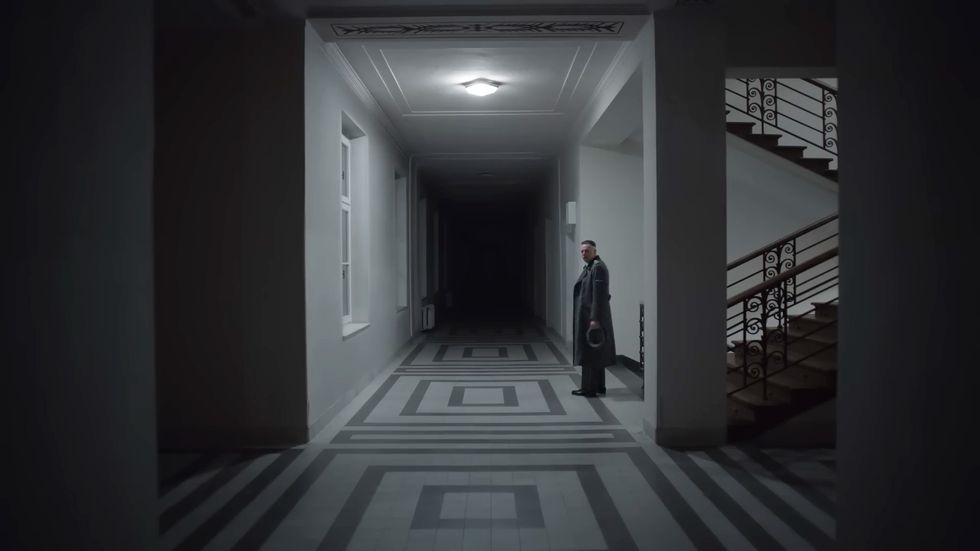
One night, after a long day of meetings and some heavy drinking, he leaves the room he is staying in and heads downstairs through an empty, gloomy building.
Suddenly, he retches, as if he is about to throw up. It could be caused by his drunkenness, but that's not all. The shadows close on him as he descends. He retches again as he stops on one floor, and something catches his attention on one side of the dim hallway.
Among the darkness, there is a tiny ray of light, which turns out to be a peephole. A door opens and a couple of women step into a room, which we quickly place as one of the chambers of the concentration camp in Auschwitz.
The Zone of Interest has jumped into present-day Auschwitz-Birkenau State Museum.
We follow the women, who are part of the cleaning personnel, as they take care of the museum. The camera focuses on the prisoners' belongings, now part of the permanent exhibition at the museum. Shoes, clothes, suitcases and other items are on display, memorialising the victims that perished in the camp.
After a few moments, we jump back to the 1940s, where Rudolf is still looking at the darkness of the corridor. He quickly composes himself and continues his way down the stairs.

This mysterious ending feels like a perfect conclusion for Glazer's thought-provoking portrait of Nazism.
Is Rudolf Höss really seeing the future in that last scene? It's open for interpretation. We could think he is being visited by a Dickensian ghost of the future in order to confront him with the consequences of his actions, and how history will judge him.
That would not be enough to make him change course, though. After all, Rudolf Höss was not "just any" Nazi officer – his ideas were essential for the efficient mass murder of over a million prisoners, mostly Jewish people.
After the events of the movie, in the spring of 1944, Höss returned to Auschwitz to oversee Operation Höss and put new methods of mass slaughter and cremation into practice. His work was so efficient that the camp struggled to deal with the number of bodies piling up in their chambers.
After World War II ended, Höss was apprehended and became one of the first high-ranking Nazi officials to confess to his crimes during the Nuremberg trials.
On April 16, 1947, he was hanged in Auschwitz.
On one hand, the ending of The Zone of Interest reminds us how these monsters were only humans choosing evil. They were people choosing to keep descending into the darkness one step at a time, repressing every bit of moral conscience even if it made them retch in disgust.
"I wanted to dismantle the idea of them as anomalies, as almost supernatural. You know, the idea that they came from the skies and ran amok, but thank God that's not us and it's never going to happen again. I wanted to show that these were crimes committed by Mr and Mrs Smith at No. 26," Glazer told the New York Times.
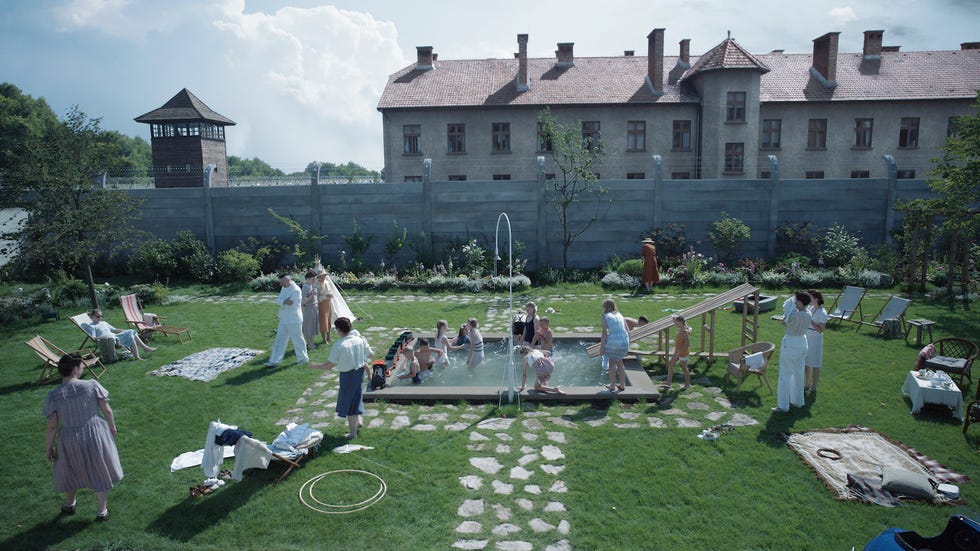
In building a bridge between past and present, the ending of the movie is also exploring the idea of legacy and remembrance.
That brief visit to Auschwitz's museum shows how society deals with the horrific episodes of the past. Much like in the main story, the only signs of the atrocities are objects. In the past, Höss' son keeps teeth from camp prisoners under his pillow as Hedwig tries a stolen fur coat on in front of the mirror. In the present, those items are displayed behind a glass in a public setting.
Glazer avoids reproducing the violent imagery we've seen in other countless movies before, from Schindler's List to Son of Saul, choosing the unsettling power of suggestion instead.
Those objects are reminders that real people existed behind the wall that separated the camp from the Höss home. They exist now through exhibits representing a past some people would like to forget, or directly erase from history.
The act of cleaning is key in the ending of The Zone of Interest.
The unemotional, routine cleaning of the museum is an uncomfortable watch, after viewers have no doubt played in their heads the harrowing collective imagery of the Holocaust during the entirety of the movie. As the cleaners vacuum the floor and wipe the glasses, we can only see the images Glazer refuses to show.
The choice of showing the museum as it's being cleaned, instead of an empty space or alongside morbid visitors, feels meaningful: it might be a warning about the dangers of detachment, of turning History into another sort of tourist attraction, and eventually letting it fall into oblivion.
However, death is not easy to clean. The horrors never fully go away. Glazer points out that, no matter how hard we try to clean it, that stain in our history will never disappear. It never should.
The Zone of Interest is available to stream on Prime Video in the UK and on Max in the US. It's also available to buy or rent digitally from Prime Video, iTunes, Microsoft Store and more.



Mireia (she/her) has been working as a movie and TV journalist for over eight years. Based in the UK, she is a former deputy movies editor at Digital Spy, and previously worked for the Spanish magazine Fotogramas. Mireia's work has been published in other outlets such as Esquire and Elle in Spain, and WeLoveCinema and GamesRadar+ in the UK. She is also a published author, having written the essay Biblioteca Studio Ghibli: Nicky, la aprendiz de bruja about Hayao Miyazaki's Kiki's Delivery Service.
During her years as a freelance journalist and film critic, Mireia has covered festivals around the world and has interviewed high-profile talents such as Kristen Stewart, Ryan Gosling, Jake Gyllenhaal and many more. She's also taken part in juries such as the FIPRESCI jury at Venice Film Festival and the short film jury at Kingston International Film Festival in London. LinkedIn


