The Color Purple spoilers follow
The Color Purple tells the struggles and tragedies of Celie Harris, a Black girl living in Deep South America in the 1900s, and is a reimagination of the Pulitzer Prize-winning novel by Alice Walker, infusing music into the story.
Writer Marcus Gardley and director Blitz Bazawule – whose work also includes Beyoncé's Black is King visual album – bring the Tony Award-winning stage musical to the big screen.
Since Walker's original book, there have been a number of retellings of Celie's journey exploring the brutality and trauma at the hands of her father and her husband, and her unbreakable bond and love for her sister Nettie.
But none truly dive into her sexuality and her relationship with Shug Avery, a free-spirited jazz-blues singer who is also Celie's husband Mister's (Colman Domingo) longtime mistress.

Related: The Color Purple original star explains why they didn't cameo in remake
What to Read Next
The 1982 novel – which broke boundaries in telling a story centred on Black women and their sexual preferences and has also been the subject of multiple book bans – details Miss Celie's attraction to Shug from their very first meeting.
Celie describes how she thought she "had turned into a man" after seeing Shug's naked "long black body with it black plum nipples" for the first time. The closest we get to this initial sexual allusion and attraction in Bazawule's take occurs when Celie finds Shug in a bath, and proceeds to trace her lathered arm and the two enter Celie's fantasy singing 'Dear God – Shug'.
The lyrics make a small attempt in explaining her initial sexual attraction ("I wash her body and it feel like I'm prayin', try not to look but my eyes ain't obeyin'"), while they're spun on the turntable of a gramophone before she slips and rejoins reality.
The writers however, keep true to Shug's wayward life. Her opening Harpo's (Corey Hawkins) Juke Joint with 'Push the Button' is possibly the raunchiest moment in the movie with its explicit lyrics and accompanying dance moves.

Related: The Color Purple movie musical lands superb Rotten Tomatoes rating following first reviews
Shug Avery's importance in Celie's life can not be understated.
Avery is the first person to tell Celie she's beautiful, and important. She encourages her to explore and empower herself sexually, calling on Celie to look at her genitals with a mirror and explore her "button". And as their relationship progresses throughout the book and over the years, the only time Celie experiences consensual caring, sexual pleasure is with Shug.
Shug is the reason why Celie discovers the fullness of womanhood, her sexuality and desires, her love for herself and her independence.
Walker's novel champions Shug and Celie's relationship, yet Bazawule's work seems to gloss over it and never establishes a long-term relationship between the two women. The closest we get to seeing their love for one another is in another dream sequence where they sing and dance in flapper dresses to 'What About Love' before sharing their first real-life kiss.
And while this is a small step forward from Steven Spielberg's 1985 adaptation, which sees Shug (Margaret Avery) tell Celie (Whoopi Goldberg) she's beautiful and that she loves her ending with a kiss on the forehead, more needs to be done to celebrate Celie's complexity and queerness.

Related: The Little Mermaid is Disney's best live-action remake
In a statement released in 2019, Walker elaborated on her real-life inspiration for Celie's character after an actress refused to play Celie on stage, saying, "Celie, the character she would have played, is based on the life of my grandmother, Rachel, a kind and loving woman brutally abused by my grandfather, and whoever was in reality the father of her children, offspring none of the family ever saw. Thankfully, after these births, and the disappearance of her children, she was barren.
"It is safe to say, after a frightful life serving and obeying abusive men, who raped in place of 'making love,' my grandmother, like Celie, was not attracted to men. She was, in fact, very drawn to my grandfather's lover, a beautiful woman who was kind to her, the only grown person who ever seemed to notice how remarkable and creative she was.
"In giving Celie the love of this woman, in every way love can be expressed, I was clear in my intention to demonstrate that she too, like all of us, deserved to be seen, appreciated, and deeply loved by someone who saw her as whole and worthy."
Related: Oppenheimer leads Oscar 2024 nominations
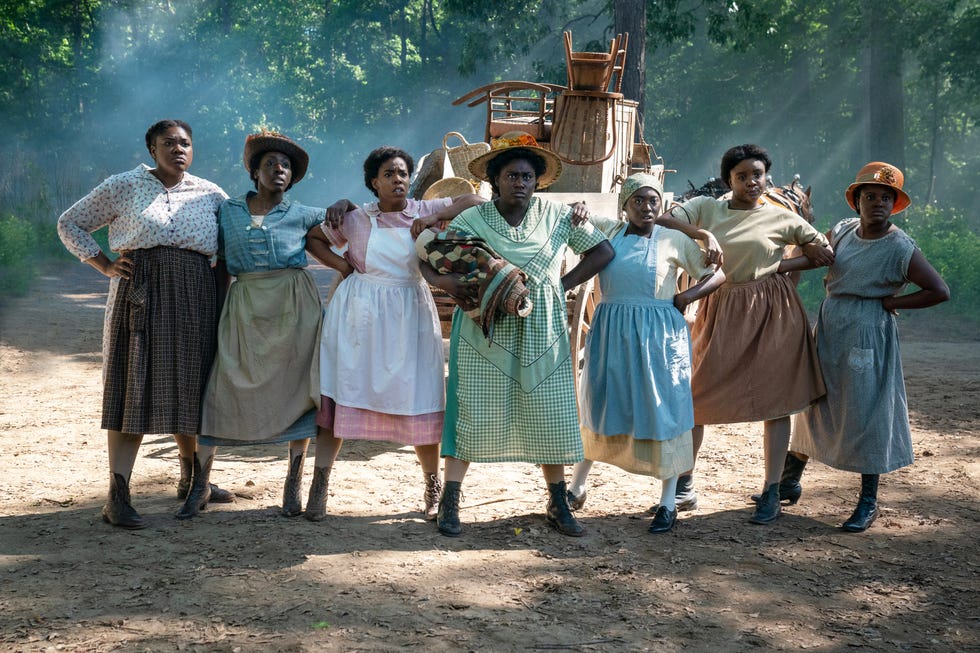
The movie does a great job in empowering and showcasing Black sisterhood through its female supporting characters such as brassy Sofia (Danielle Brooks) who stands strong against domestic violence and micro-aggressions, and whose life is turned upside down after being physically and emotionally torn down by the white Mayor's wife Miss Millie (Elizabeth Marvel), finding redemption through Celie's sisterly love.
And let's not forget Squeak/Mary Agnes (HER) who finally stands up for herself against Harpo after being continually overlooked, spoken for and shut down.
All to the good: yet it misses the mark when it comes to Celie's fullness, sexuality and womanhood.
The Color Purple is now out in cinemas.
You Might Like...



Photo Director, Hearst UK
Shyvonne Thomas is Digital Spy's Photo Director, looking after Digital Spy's and Hearst's digital brand visuals across the board. She also writes and conducts interviews specialising in the Power shows, anything Beyoncé, family days out, as well as championing content across Black TV shows and movies.
Having started her career as Shopping Assistant for Mother & Baby and Pregnancy and Birth magazines in 2010, Shyvonne moved on to become Picture Assistant at heat magazine in 2012, before joining the Daily Star, Express and OK! websites as Galleries Editor in 2014.
Shyvonne is an NCTJ-accredited journalist and studied an honours degree in Journalism. In 2021, Shyvonne was shortlisted for the PPA Unsung Hero Award. Shyvonne is also a proud mum.


