
Daniel Kaluuya's brilliantly defiant directorial debut The Kitchen is set in a near future that looks very much like our present — as if we're already living in a dystopia.
A classic David-and-Goliath story for the gentrification era, this Netflix movie is a pledge to save social housing, a harrowing look at police brutality and a commentary about cities becoming wealthy shells devoid of life, diversity and culture.
At its core, though, this is the story of a man readjusting his priorities and a child searching for love in a hopeless place.
What to Read Next
Co-directed with Kibwe Tavares and co-wrote by Kaluuya and Joe Murtagh, the story follows Izi (played by Top Boy star Kane Robinson), a reluctant resident of an endangered London housing estate (known as The Kitchen) who dreams of getting out of there as fast as possible.

Despite the futuristic tech that can be spotted around the city, this crowded estate is almost in ruin due to an ongoing fight against an authoritarian government that wants to kick them out. Police raids are normal, electricity rarely works and water runs scarce.
It's not an ideal place to live, and yet the community is fighting tooth and nail to save it. Not Izi, though. "When shit gets real, I’m saving myself," he tells a neighbour.
He wants to relocate to a one-room luxury apartment provided by the housing company Buena Vida. He has been waiting for eight months, earning money through his job at the ecological funeral home Life After Life (where poor people's ashes are recycled and used as plant compost) while slowly moving up the waiting list.
Just when that dream is in his grasp, he meets 12-year-old Benji (Jedaiah Bannerman). The kid's mother, Izi's former girlfriend, just died. Despite his best efforts to not care about what happens to Benji, Izi decides to take him to The Kitchen, eventually reassessing his internalised classism.
Although proudly unique, the movie is full of cinematic echoes – it's a fascinating blend of the rebellious motorised street-fighting of movies like Romain Gavras' Athena and Ladj Ly's Les Misérables, and Minority Report's futuristic views on oppression, plus a little bit of Blade Runner's ghost-city design with neon signs sparkling through misty streets.
Most notably, Spike Lee's spirit lives in this story. Former Arsenal footballer Ian Wright plays Lord Kitchener, part DJ, part moral compass in The Kitchen, who seems to draw inspiration from Samuel L Jackson's Mister Señor Love Daddy from Do the Right Thing.
We wouldn't have been surprised to hear someone in the background screaming: "Wake up!"
Still, Netflix's movie resorts to a formula that feels closer to a traditional social drama, striving for straightforwardness rather than arthouse flair.
Kaluuya and Tavares are clearly drawn to the adult-child dynamic, making the sci-fi and dystopia elements more of a background choice than anything. What we're seeing in the story doesn't feel time-specific.
In fact, the movie's powerful images evoke many present-day situations – unfair evictions, wealthy-oriented city redevelopment, racism, police brutality and more.

Now, with the focus being so clearly on Izi and Benji's relationship rather than the world around them, the movie can sometimes feel slow-paced, especially if viewers expected a more thriller-y proposition.
That also creates a certain distance with Robinson and Bannerman's characters, whose inner conflicts don't feel as moving as they should, despite the actors' notable performances. Besides a couple of endearing moments, like when they laugh over a Hawaiian-themed lamp, the movie's heart beats too faintly.
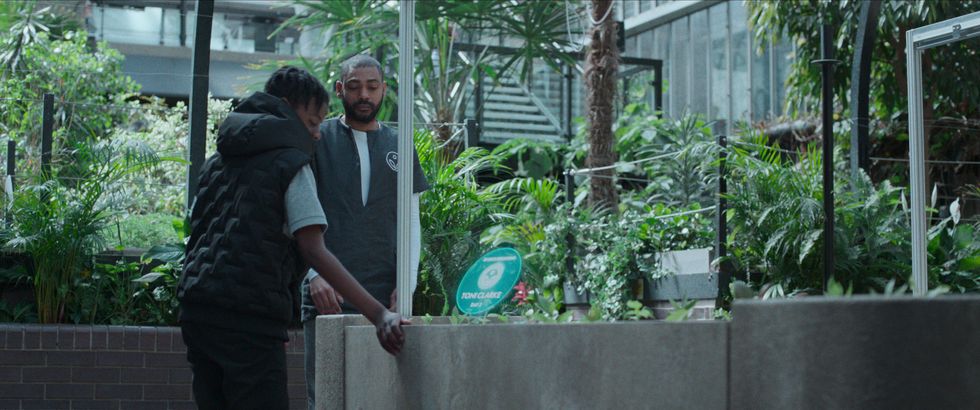
In contrast, The Kitchen's community roars with life. While being on the verge of eviction, the neighbours enjoy rollerblading in the basement, grow their own communal garden on the terrace, show up to the local hairdresser and strengthen their chosen families.
Also, from being an issue, the slow pace of the story signals something positive.
The movie is not seduced by the need to be spectacular, action-driven or having an all-out war erupting in the building to provide entertainment. Instead, it's loyal to the family conflict and its political ideas, which are ultimately more powerful.
Perhaps it's a run-of-the-mill family drama, but The Kitchen is an exceptional political movie.
If anything, it shows some consistency – as Lord Kitchener puts it, the we goes above the I, the community is more important than the individual.

The Kitchen is now available on Netflix.
You Might Like...



Mireia (she/her) has been working as a movie and TV journalist for over eight years. Based in the UK, she is a former deputy movies editor at Digital Spy, and previously worked for the Spanish magazine Fotogramas. Mireia's work has been published in other outlets such as Esquire and Elle in Spain, and WeLoveCinema and GamesRadar+ in the UK. She is also a published author, having written the essay Biblioteca Studio Ghibli: Nicky, la aprendiz de bruja about Hayao Miyazaki's Kiki's Delivery Service.
During her years as a freelance journalist and film critic, Mireia has covered festivals around the world and has interviewed high-profile talents such as Kristen Stewart, Ryan Gosling, Jake Gyllenhaal and many more. She's also taken part in juries such as the FIPRESCI jury at Venice Film Festival and the short film jury at Kingston International Film Festival in London. LinkedIn


