
Poor Things mild spoilers follow.
Once Bella Baxter tasted pleasure by sticking an apple into her unmentionables, she was never the same.
Emma Stone's fearless, horny-to-a-fault heroine in Poor Things doesn't play by the rules of polite society (by any rules, actually), so she embarks on a journey of self-discovery and emancipation where sex and desire are essential.
What to Read Next
Yorgos Lanthimos' movie is an absurdist, satirical, free-spirited fairytale that dives head first into Bella's unconventional journey into her own idea of womanhood.
It may evoke real-life struggles, but make no mistake – Bella is in a league of her own, as every bit of "furious jumping" (as she describes her sexual encounters) is a battle for her freedom of body, mind and soul.
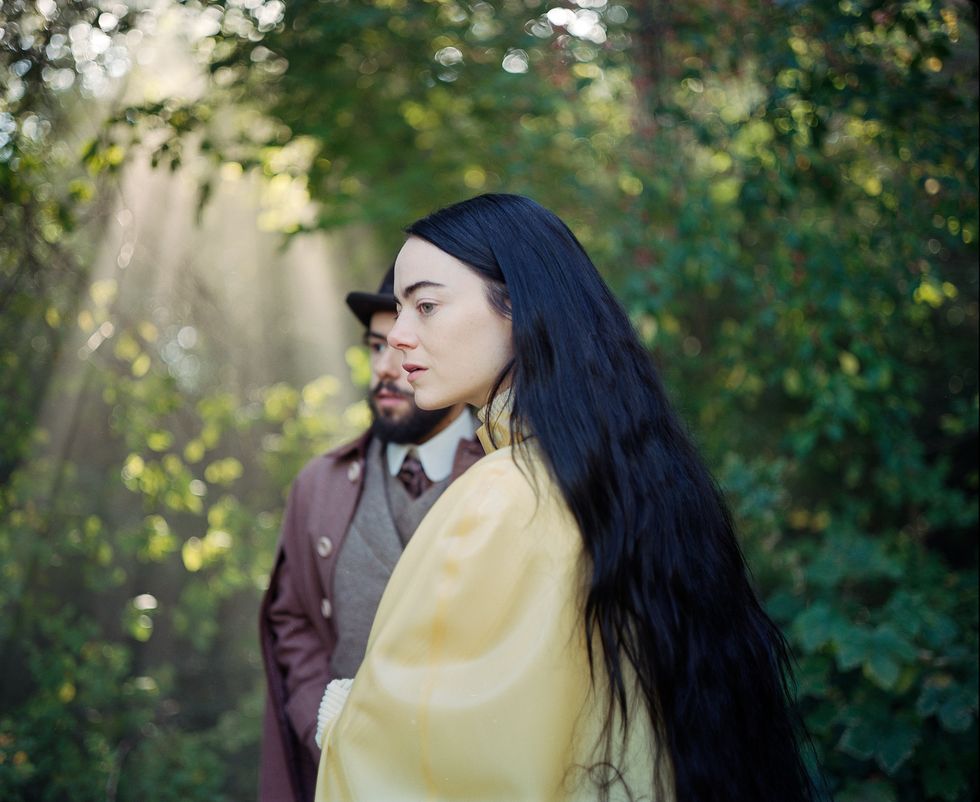
Based on Alasdair Gray's 1993 novel, which is a reinterpretation of Mary Shelley's Frankenstein, the story starts when the ambitious surgeon Godwin Baxter (Willem Dafoe) decides to insert the brain of an unborn child into the head of its mother, who just died by suicide. Yeah, really.
The result is a baby in a grown woman's body, an experiment that soon proves successful as her brain develops at an accelerated pace and the newly 'born' Bella Baxter embraces the world with enthusiastic hunger.
From the start, Poor Things evokes very interesting ideas. For example, Bella's situation suggests women are being infantilised, patronised and sexualised all at the same time, as well as the fine line that separates girls from women. On the other hand, many of these initiated conversations never fully finish, sometimes feeling more like a monosyllabic interchange.
Luckily, Stone is a force of nature filling everything with a sense of purpose and depth.
She embraces the ridiculousness of walking like a toddler, as well as wearing increasingly growing puffed-up sleeves and stripping down to full nudity for the most demanding role of her career. You can hardly imagine this movie working as well as it does without her shining in front of the cameras.
Despite being surrounded by a uniquely crafted world of crooked angles, fisheye lenses, mad Terry Gilliam-esque settings and hysterical clothing, Bella Baxter always rises above it while sprinting towards her own liberation.
For that, sexual pleasure is her most effective tool.
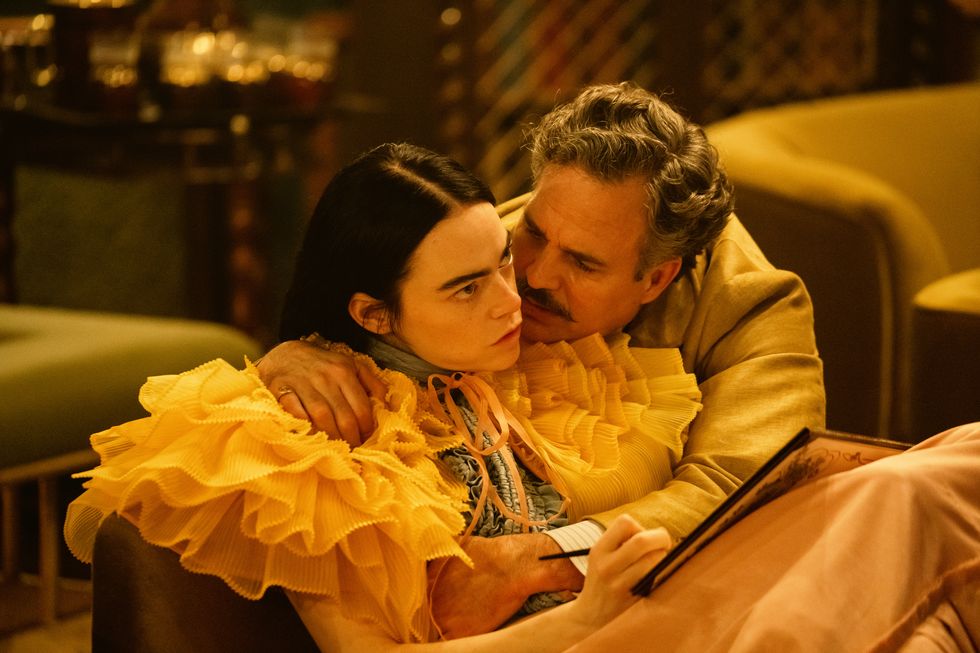
It's no surprise that Bella's sexual awakening is the first step towards her emancipation from "God". She is soon charmed by lawyer-by-day, womaniser-by-night Duncan Wedderburn (Mark Ruffalo) — or she charms him, more like it — and starts a European vacation as chaotic as it is productive for her understanding of the world.
Staying true to her brutal sincerity and her entertaining inability to contain any kind of impulse, she navigates through the prickly realities of the world, crying as she learns of injustice, getting into socialism studies and finding sisterhood while becoming a sex worker in Paris.
"We are our means of production," Bella states to a stone-faced Duncan.
Her body is the tool by which she seizes what is rightfully hers, which is why women having choices is a massive red flag for the patriarchy.
It's easy to see that every male character in Poor Things is trying to control her, whether from a need to protect her or to get her into bed. One man even plans to submit her to female genital mutilation in order to keep her on a short leash.
It seems nothing is scarier to a patriarchal society than women's control over their own bodies – after all, they are the battleground for female liberation, and here Bella is leading her own war.

A more PG version of this story, Greta Gerwig's Barbie, also uses satirical comedy to explore a childlike female character bursting her pink bubble and finding her own journey into womanhood, questioning gender stereotypes in the process.
In both movies, the heroines move around gargantuan, artificial stages that suggest existence is performative, that being alive is a form of theatre constrained by society's rules. What's beautiful about Barbie and Bella is that they choose to exist beyond that, and are able to break convention with their raw passion for living.
Granted, they are very different movies. Poor Things is pure provocation, while Barbie has more heart. Perhaps one could learn much from the other, even if they inhabit completely different universes – Lanthimos' film could have found ways to further deepen into the fascinatingly complex feminist discourse, while Greta Gerwig's could have ventured into sexuality.
Now, movies are not what we want them to be, but just what they are. And both of these films are outstanding, beautifully smart, female-driven coming-of-age adventures that can fuel conversation for hours.
They also question what it means to be a woman in the world.
Poor Things is about how liberating it can be to ignore the standards of femininity. Bella doesn't look at the world as it is, but as she wants it to be.
Poor Things is now out in UK cinemas.
You Might Like...


Mireia (she/her) has been working as a movie and TV journalist for over eight years. Based in the UK, she is a former deputy movies editor at Digital Spy, and previously worked for the Spanish magazine Fotogramas. Mireia's work has been published in other outlets such as Esquire and Elle in Spain, and WeLoveCinema and GamesRadar+ in the UK. She is also a published author, having written the essay Biblioteca Studio Ghibli: Nicky, la aprendiz de bruja about Hayao Miyazaki's Kiki's Delivery Service.
During her years as a freelance journalist and film critic, Mireia has covered festivals around the world and has interviewed high-profile talents such as Kristen Stewart, Ryan Gosling, Jake Gyllenhaal and many more. She's also taken part in juries such as the FIPRESCI jury at Venice Film Festival and the short film jury at Kingston International Film Festival in London. LinkedIn


