
Napoleon Bonaparte died on May 5, 1821, on the island of Saint Helena.
That much we know to be true, and yet the cause of his death has been up for debate between historians and scientists for over two centuries. With Ridley Scott's Napoleon out in cinemas, the question might resurface once again.
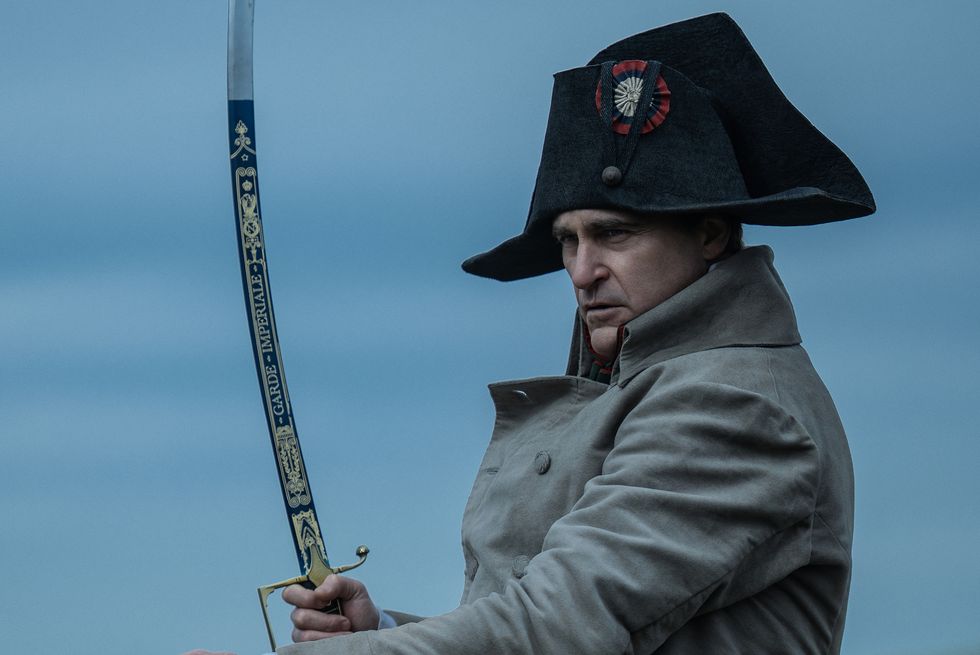
Starring Joaquin Phoenix as the self-proclaimed Emperor and The Crown's Vanessa Kirby as his first wife Joséphine, the movie covers most of Napoleon's lifespan, from the moment he starts gaining notoriety due to his military talents to his ultimate downfall before the British.
What to Read Next
Napoleon is not too preoccupied about being historically accurate (to those who have a problem with that, Ridley Scott said: "Get a life"), so we're here to examine a little bit closer how Napoleon's death really came down.
Was it a natural death? Was he poisoned? Were Napoleon's last words those the movie claims?
How did Napoleon die?
After Napoleon was defeated at the Battle of Waterloo in 1815, the British decided to avoid turning him into a martyr and exiled him instead to the tiny, isolated island of Saint Helena, in the South Atlantic Ocean.
After spending two months at his friend William Balcombe's home, Napoleon was moved to the not-so-nice Longwood House, a neglected property. Napoleon's servants complained of "colds, catarrhs, damp floors and poor provisions" in the house (via History Channel).
In order to prevent the French leader from abandoning his exile, as he managed to do in Elba in 1815, the British governor of the island, Hudson Lowe, restricted his freedom of movement and monitored his correspondence.
As expected, Napoleon was not having any of that, quickly leading his own home-based rebellion by locking himself inside the property to obstruct the daily check-ups from Lowe's men.
Longwood House's poor living conditions, Napoleon's paranoia-fuelled confinement and the overall lack of exercise meant his health rapidly worsened. The symptoms included vomiting, abdominal pain and constipation.
Four years after his arrival to Saint Helena, on May 5, 1821, Napoleon passed away.

Was Napoleon poisoned?
After 200 years, it's still not entirely clear what killed Napoleon Bonaparte.
An autopsy carried out by his physician Francesco Antommarchi right after Napoleon's death determined he died of an ulcerating stomach cancer. But, what caused the disease?
A theory claiming Napoleon was poisoned quickly made its way into the conversation.
The former Emperor himself sparked suspicions when he said three weeks before his death: "I die before my time, murdered by the English oligarchy and its assassin." (via American Museum of Natural History)
He might have meant that regarding his isolated exile, which severely affected his health. Or maybe he did think he was being poisoned. The theory was fuelled by his body and locks of his hair testing positive for arsenic.

However, that doesn't necessarily mean he was purposefully being poisoned with that substance. As many historians and scientists have pointed out over the years, arsenic was actually quite common at the time, particularly used in wallpapers, artificial dyes, candles, soap and more.
Napoleon could have been exposed to the poison at his home in Saint Helena, since it was an old and decaying building, or he could have been exposed to it during his life.
In fact, in 2008, an Italian team tested locks of hair from his ex-wife Joséphine, finding they too had similarly high arsenic levels.
"So sorry to disappoint. Napoleon's doctor got it right the first time: The defeated emperor died of advanced gastric cancer," explained Dr. Robert Genta of Southwestern Medical Center at the University of Texas in Dallas in an interview with ABC News in 2007.
"It's become fashionable to ask if the course of history would have been changed if he had somehow escaped his exile, gone back to Paris, perhaps reconquered France," continued Genta.
"And the answer is probably no. His cancer was so advanced that even if somebody could have smuggled him out, he was in such terrible shape that he would have died very quickly."

Is Ridley Scott's movie accurate about Napoleon's death?
Once Napoleon is exiled in Saint Helena after his disastrous defeat in the Battle of Waterloo, the movie doesn't take too long to reach the end of his life.
We see him seated in a garden, looking at two girls playing. Shortly after, he just collapses, falling down the chair.
The shot seems to evoke the first scene in the movie, when Napoleon attends Marie Antoinette's execution. When the guillotine cuts her head clean off, his expression is serious, perhaps sensing this moment as a warning for what's to come to him – he will cling to power as cruelly and mindlessly as the French aristocracy, after all.
His head falling to the side in that last image of the movie seems to imply a sort of beheading. Visual poetry for a man who's lost his mind? Or a nod to the murder theories surrounding his death?
Perhaps in Ridley Scott's four-hour director's cut – which will be released on Apple TV+ after the movie's theatrical run – we'll get more details about these last few years of the French leader's life, as well as his last breath.
As far as the theatrical cut goes, the movie does not directly depict Napoleon's death.

What were Napoleon's last words?
In Napoleon's credits, Ridley Scott includes the words popularly believed to be Napoleon's last.
Those words are "La France, l'armée, tête d'armée, Joséphine," which translates to "France, the army, head of the army, Joséphine" in English.
It's hard to know for a fact if Napoleon actually said these words upon his death.
Researching Napoleon's last words, writer Shannon Selin gathered the accounts of several witnesses, including Napoleon's valets Louis-Joseph Marchand and Louis Étienne Saint-Denis, Napoleon's Grand Marshal, General Henri Bertrand and doctor Francesco Antommarchi.
Selin determined that Napoleon might have said those words, although he would have said them separately, not in the same sentence. She also points out that Napoleon's obsession with legacy and being remembered according his own propagandistic narrative might have driven his entourage to put together those words, although of course that's just a theory.
Either way, the records published by Napoleon's men are the only proof that those words were ever spoken by a feverish Napoleon before he died.
If anything, it's an accurate collection of his life-long obsessions.
Napoleon is now out in cinemas and will be released on Apple TV+ at a later date.
You Might Like...



Mireia (she/her) has been working as a movie and TV journalist for over eight years. Based in the UK, she is a former deputy movies editor at Digital Spy, and previously worked for the Spanish magazine Fotogramas. Mireia's work has been published in other outlets such as Esquire and Elle in Spain, and WeLoveCinema and GamesRadar+ in the UK. She is also a published author, having written the essay Biblioteca Studio Ghibli: Nicky, la aprendiz de bruja about Hayao Miyazaki's Kiki's Delivery Service.
During her years as a freelance journalist and film critic, Mireia has covered festivals around the world and has interviewed high-profile talents such as Kristen Stewart, Ryan Gosling, Jake Gyllenhaal and many more. She's also taken part in juries such as the FIPRESCI jury at Venice Film Festival and the short film jury at Kingston International Film Festival in London. LinkedIn


