Killers of the Flower Moon ending spoilers follow.
Before Killers of the Flower Moon's Los Angeles premiere, Christopher Cote – one of the movie's Osage language consultants – thoughtfully explained his complicated feelings about Martin Scorsese's new movie, now available to watch on Apple TV+.
"As an Osage, I really wanted this to be from the perspective of Mollie [Lily Gladstone] and what her family experienced, but I think it would take an Osage to do that," he told The Hollywood Reporter.
Cote added that Scorsese did a "great job representing our people", but that the story – and, therefore, this recreation of a very real dark period in Osage history – is told from the perspective of Ernest Burkhart (Leonardo DiCaprio), who conspired to kill an entire Osage family.
It's a valid criticism of the movie and one that Cote put down to the fact that Killers of the Flower Moon "isn't made for an Osage audience, it was made for everybody who is not Osage".
It also appears to be something that was on Scorsese's mind as he directly addresses it in the movie's powerful and audacious ending.
What to Read Next
But to go into how he does it and why, we need to go into some major spoilers, so look away if you haven't seen the movie.
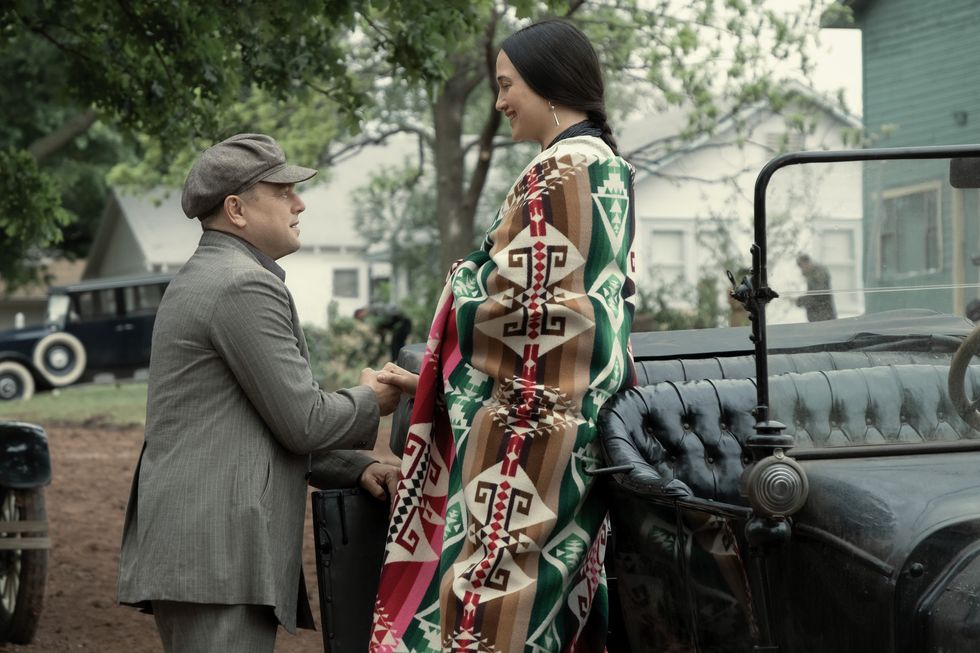
Killers of the Flower Moon ending explained
After Ernest lies to Mollie for the final time by pretending that it was insulin in the shots he was giving her, the movie surprisingly jumps forward an unspecified number of decades to a time when the Osage murders have become a true-crime story.
We see a live stage recording of a radio play acting out the aftermath of the murders, complete with foley sound effects, an orchestra and actors playing the roles of William King Hale, Ernest Burkhart and more.
There's not such a meta twist that it's Robert De Niro and Leonardo DiCaprio reprising the roles. Instead, it's the likes of Jack White (yes, of The White Stripes fame) and Larry Fessenden taking on multiple roles in the retelling of the murders.
We hear what happened to King (released on parole in 1947 despite a life sentence, died in 1962) and Ernest (released on parole in 1937, died in 1986) in a spin on the usual end title cards for a movie based on a true story.
But the most impactful moment comes when it's time to tell what happened to Mollie. The stage falls silent as the radio show's producer comes out, played by none other than Martin Scorsese himself.
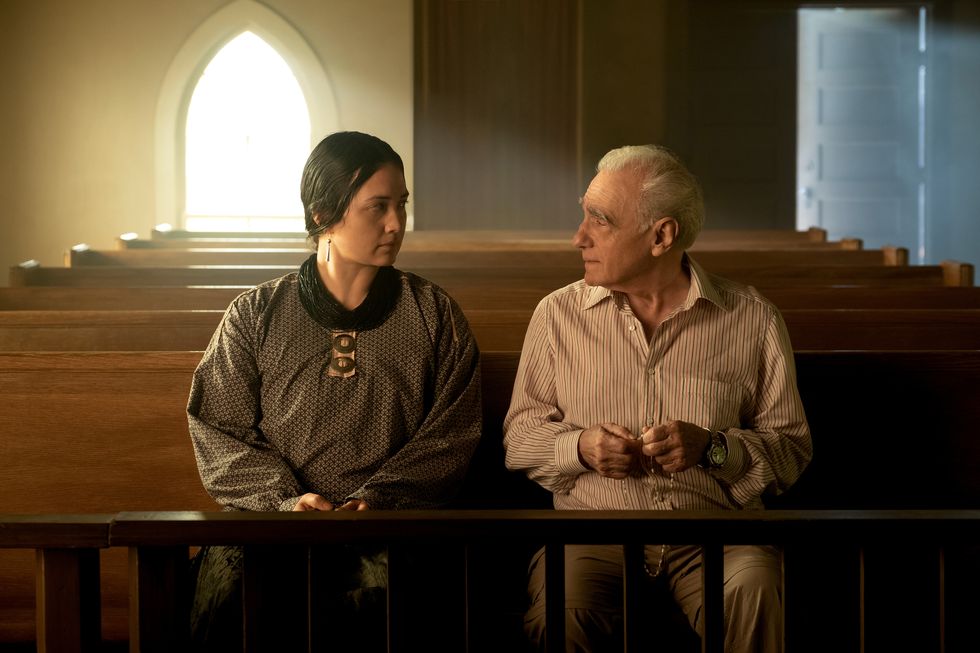
Watch Killers of the Flower Moon on Apple TV+
He takes to the microphone to read out Mollie's obituary, how she remarried after Ernest's conviction, but later died in 1937 from causes unrelated to her earlier poisoning by Ernest. Most tellingly, Scorsese ends his cameo by saying her obituary had no mention of the Osage killings.
It's a stark reminder that as gripping and dramatic as the previous three-plus hours have been, Killers of the Flower Moon is only a retelling of a tragic real-life tale that saw entire Osage bloodlines wiped out.
Scorsese wants to remind you that he is only telling you his version of the story, but it's not necessarily his story to tell. It's underlined by the movie cutting to a shot of the Osage people which moves to a bird's-eye view shot to confirm we can only really view the story from a distance if we're not Osage.
Too often, true-crime stories are sensationally told with all the lurid details and they lose track of the real lives affected by the events. Scorsese provokes you into remembering that this is a true story and, even though the Osage murders were almost wiped from history, you need to remember the impact the events had on the Osage.
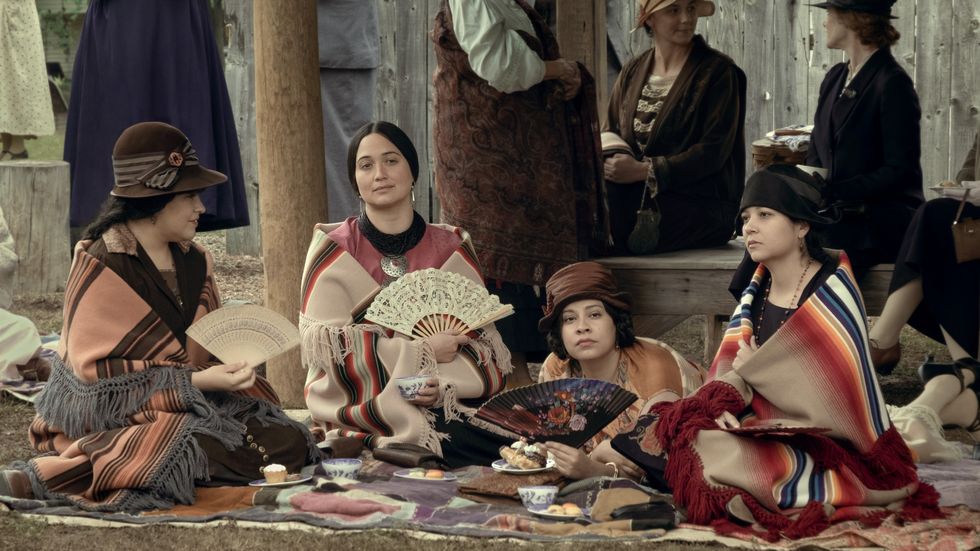
Scorsese breaking the fourth wall to literally become a narrator of the story holds more power than any end title cards could.
They might have told us the murders were all but forgotten and the villains got away with minimal punishment, but Scorsese makes sure those statements hang in the air to give them the weight they deserve.
"I try to make it as truthful as possible, as honest, I should say, as possible," Scorsese explained of his cameo.
"Therefore, I said we have to end it with one of those radio shows where you see after all this, that's what the American public was led to think of or believe of the situation. Then we had the obit and I didn't know if I could direct the actor to do that.
"And having lived with the Osage and everybody there in Oklahoma for so long, I felt I had to try it myself. I said, 'Listen, let me do it. If it doesn't work, I know the angle. I can get another actor to do it.'
"But as I was doing it, I kind of felt it. And I also felt that in a way, as I say, my own complicity in life and the world as it exists, trying to have compassion for it. Those who are suffering in the world, that's all."
It can be equally true that Killers of the Flower Moon isn't entirely perfect in its centring of Ernest in the tale and also that Scorsese told it as authentically as he could, fully aware of his own shortcomings.
Killers of the Flower Moon is available to watch now on Apple TV+.


Movies Editor, Digital Spy Ian has more than 10 years of movies journalism experience as a writer and editor. Starting out as an intern at trade bible Screen International, he was promoted to report and analyse UK box-office results, as well as carving his own niche with horror movies, attending genre festivals around the world. After moving to Digital Spy, initially as a TV writer, he was nominated for New Digital Talent of the Year at the PPA Digital Awards. He became Movies Editor in 2019, in which role he has interviewed 100s of stars, including Chris Hemsworth, Florence Pugh, Keanu Reeves, Idris Elba and Olivia Colman, become a human encyclopedia for Marvel and appeared as an expert guest on BBC News and on-stage at MCM Comic-Con. Where he can, he continues to push his horror agenda – whether his editor likes it or not.


