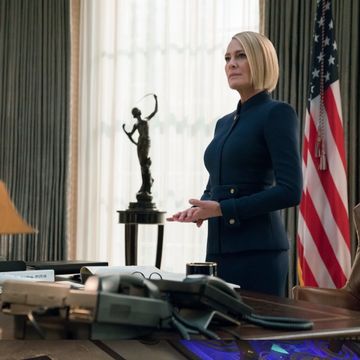
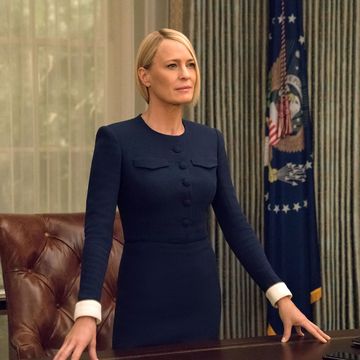
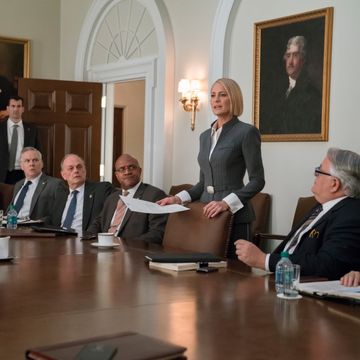
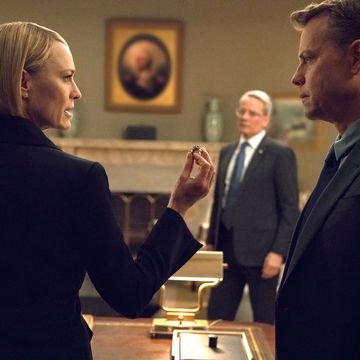
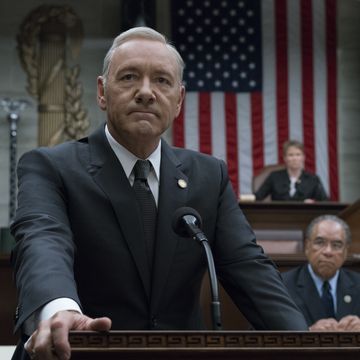
Frank Underwood has long been infallible. His seemingly unstoppable rise to power was wearing thin long before the end of season two - it's hard to ratchet up much in the way of dramatic stakes when your protagonists win every time. With straw men like Raymond Tusk and President Walker as their only opponents, Frank and his equally unscrupulous wife Claire had more or less plain sailing to the White House.
But as it turns out, it's lonely at the top, and frustrating, and vaguely humiliating. Season three begins with Frank's approval ratings in the tank, and his own cabinet advising against running for the 2016 election. In place of the oily glad-handing that got him into the Oval Office, we now see Frank shouting at his insubordinate team in impotent rage, falling prey to the same legislative sticky wickets that allowed him to undermine Walker.


House of Cards: Frank Underwood's best/worst moments
House of Cards stars on a surprising season 3 and what's next
More intriguing than the circumstance itself is the suggestion that Frank may simply be losing the plot. He's always been a hollow character, motivated by the shark-like urge to simply keep moving forward and upward, and now that he's at the top he's floundering. Part of the fun in House of Cards has always been watching Frank out-manoeuvre everyone around him, but all of his strategic moxie seems to have gone out of the window.
I certainly hope this is intentional, because I can't figure out how else to account for some of the bizarre decision-making we've seen from Frank in the first six episodes. First of all, he's pushing through what is surely guaranteed to go down as some of the least popular legislation in history, with the 'America Works' problem proposing to create more jobs by cutting government entitlement programs (essentially benefits in Brit terms). Because screw old people and military veterans!
"The American dream has failed you," Frank tells the nation in episode two's speech. "Let me be clear: You are entitled to nothing." Inspiring stuff. It's one thing for Frank to say he's not running in 2016 and therefore isn't worried about re-election (though that's questionable to say the least), but surely alienating this many people with a policy this un-Democratic can't be a great move legacy-wise. No matter how many times the show reminds me Frank is a Democrat, my brain doesn't quite accept it, and storylines like this aren't helping.
What to Read Next


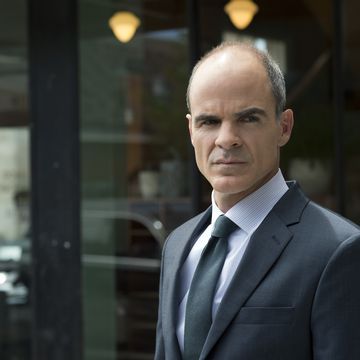
Then there's alienating Doug Stamper, which just might end up being the biggest mistake Frank ever makes. This is one of the few people who's got absolutely every inch of dirt on Frank and the people he's murdered. Yes, Stamper has proved himself to be exceptionally loyal, but he's also recovering from a traumatic brain injury which we've learned could make him unstable and prone to sudden mood swings.
So maybe Frank should have offered him a more compelling carrot than that half-hearted "My only care is that you get better" chat, during which he somehow failed to notice that Stamper's arm was practically at right angles from his body. By episode four we see Stamper seemingly defect to Frank's political rival Heather Dunbar, who's officially running in 2016 after Frank's failed attempt to sideline her into his own cabinet.
My biggest question about this is how on earth Frank didn't see it coming. He's got Seth checking in at regular intervals, but if anyone knows how to pull off subterfuge it's Stamper, and right now this just feels like sloppiness Frank can't afford. If he's lucky, this turns out to be a double bluff, and Stamper will return to him with game-changing dirt on Heather.
Stamper's return from the dead, which dominates much of season three's premiere, might be the series's biggest ask yet in terms of suspension of disbelief - this moment from the season two finale feels in retrospect like a cheap shot which makes the reveal close to ridiculous. Still, Stamper's an intriguing blend of sympathetic and sinister (I had forgotten exactly how creepy he became with Rachel last season), and there's rich dramatic potential in his betrayal of Frank - or equally in his return to his old position, which might be the missing ingredient Frank needs to get back ahead.


I wouldn't be surprised if Frank's uncharacteristically sloppy moves are building to the revelation of a grand plan down the road. His asides to camera have been rarer and less in-depth so far this season, as though we're no longer quite seeing the whole story - and there's a newly combative edge to them which emerges in episode six's laugh-out-loud sting in the tail: "What are you looking at?"
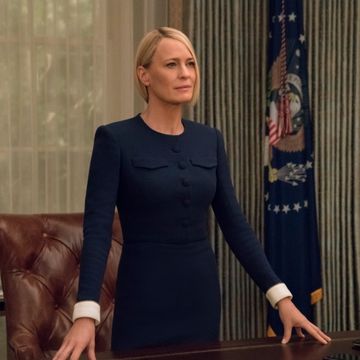
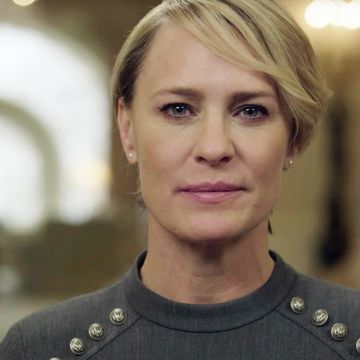
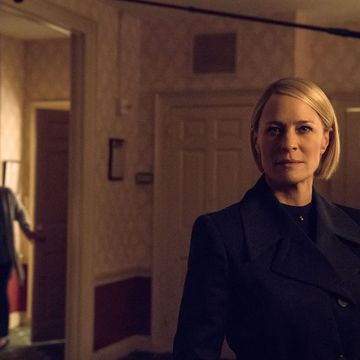
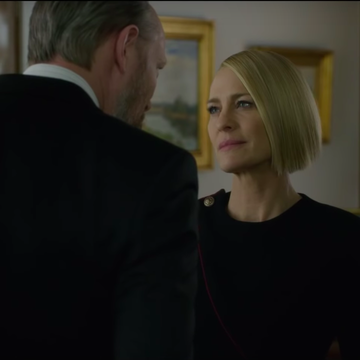
But Claire is certainly noticing his hesitation and she's having none of it, openly telling Frank she "refuses to indulge" his apparent self-doubt. In previous seasons, the numerous Lady Macbeth comparisons haven't quite held water because Claire and Frank seemed evenly matched in terms of their ruthless ambition, with her the more morally questioning of the two. In season three the analogy has become more literal - Claire is the driving force behind Frank, who seems to be questioning his actions for the first time.
The lack of any moral consequence is one of the elements that keeps me from fully embracing House of Cards. Peter Russo and especially Zoe Barnes were rapidly forgotten after Frank dispatched them, and neither murder seemed to weigh on him for a second. But in episode four, he's confronted by Mahmoud, one of the many civilian victims of the drone strike he ordered. "There's a fine line between duty and murder," Mahmoud tells him, and while Frank took leave of that boundary quite some time ago, the meeting actually seems to affect him.


At the very least it drives him to church, where he grandstands on the subject of absolute power in a scene that felt consciously like a riff on Martin Sheen's iconic cathedral speech in The West Wing. Unsurprisingly, it's the Old Testament God that makes sense to Frank, while the bishop tries to argue that "there's no such thing as absolute power for us, except on the receiving end. Using fear will get you nowhere."
And then Frank literally breaks Jesus. This whole scene sums up the level on which House of Cards works best - slick, knowing and about as subtle as a sledgehammer, and "I've got God's ear now" is such a gloriously audacious, almost panto-level parting shot that you have to fight the urge to applaud.
The only thing we know for sure in House of Cards is that the fall is inevitable - it's right there in the title. The house will stand for as long as the Underwoods' marriage holds, but six episodes in that's already looking shaky.


It's not always easy to track this relationship's ups and downs, because Frank and Claire don't talk to each other like humans. Even when they're alone together they speak formally and carefully, putting on a display for each other as much as anyone. Claire mechanically humping a tearful Frank back to his normal self in episode two (which, by the way, grim) certainly put paid to my theory that theirs is an essentially asexual show marriage, but I do think it's a partnership that hinges entirely on both getting what they want from it. Episode six brings it to crisis point, with the suicide of gay rights activist Michael Corrigan violently dividing the Underwoods.
To me, this episode would have had more impact - and made more sense thematically - if Frank had been the one in the cell with Michael, given that we know he is at least bisexual. There's a reason why the threesome with Meechum is one of the only moments everybody remembers from season two, and it's not shock value - it's because this, along with the visit to his alma mater in season one, is about the only time we've seen something more nuanced than naked ambition from Frank. The Russia storyline has thus far felt like a missed opportunity for more character-building in this vein.
Still, Robin Wright is utterly compelling throughout those two-hander scenes, and Claire being given so much more development than Frank isn't necessarily a bad thing. It's certainly not new. What it does is create a central imbalance in the show which reflects the balance of power within the narrative. That's never clearer than in the game-changing fight they have, after Claire is stirred by Michael's suicide to publicly denounce the Russian president Petrov (Lars Mikkelsen), thus undoing months of political and diplomatic work.
"I should never have made you ambassador," Frank says, referring to her dubious appointment at the UN. "I should never have made you president," she spits back, in a killer line that spotlights just how passive Frank has become both in his own marriage and in his own story.
Frank has never really fit the anti-hero mould, lacking the humanity and relatable conflict of a Walter White or a Tony Soprano, but maybe that's because this was never actually his story. I think the true anti-hero of House of Cards might turn out to be Claire Underwood, while Frank is relegated to the less layered role of antagonist to be fought and overcome.


Talking points:
- Did Gavin's whole pretending-to-have-HIV plan seem a bit unnecessarily convoluted to anyone else? I understand the need to get close to Lisa, and obviously it worked, but I'm a bit lost on why he thought that would be the thing that got her to disclose Rachel's location.
- So, who is going to be this season's Peter Russo/Zoe Barnes? We're six episodes in and nobody significant has snuffed it yet.
- Speaking of Zoe, I'm glad to have Kim Dickens's Kate around as a much more savvy replacement, who is especially bad news for Seth after he ousted Ayla: "Can't boot two reporters in a row, certainly not two women." It's still odd to me how nobody but Lucas seemed interested in looking further into Zoe's death.
- I am thoroughly enjoying Lars Mikkelsen's performance as Not Putin, and again he's a character who seems like a worthy adversary in contrast to previous seasons' offerings.
- Do we think Frank's strange decision-making is part of a bigger plan? Or is he genuinely more effective at scheming his way to the top than he is at actually ruling? The latter would be very much in-keeping with the arc of Richard III, which Spacey has acknowledged as a key touchstone for House of Cards. I'm just waiting for Frank to start being tormented by the ghosts of people he's killed.
- On a similar note, is Stamper just trying to get dirt on Heather Dunbar, or has he truly defected to the enemy?
- We need to talk about the eggs. Claire's retching, followed immediately by egg-cooking… pregnancy foreshadowing? It's right on the same heavy-handed level as Frank literally smashing Jesus to pieces in episode four, and given the hint that Claire's abortion lie might come back to haunt her, I can see this happening.

Emma Dibdin is a freelance writer based in Los Angeles who writes about culture, mental health, and true crime. She loves owls, hates cilantro, and can find the queer subtext in literally anything.